Outdoors Pendant Lamp use safely and weatherproof
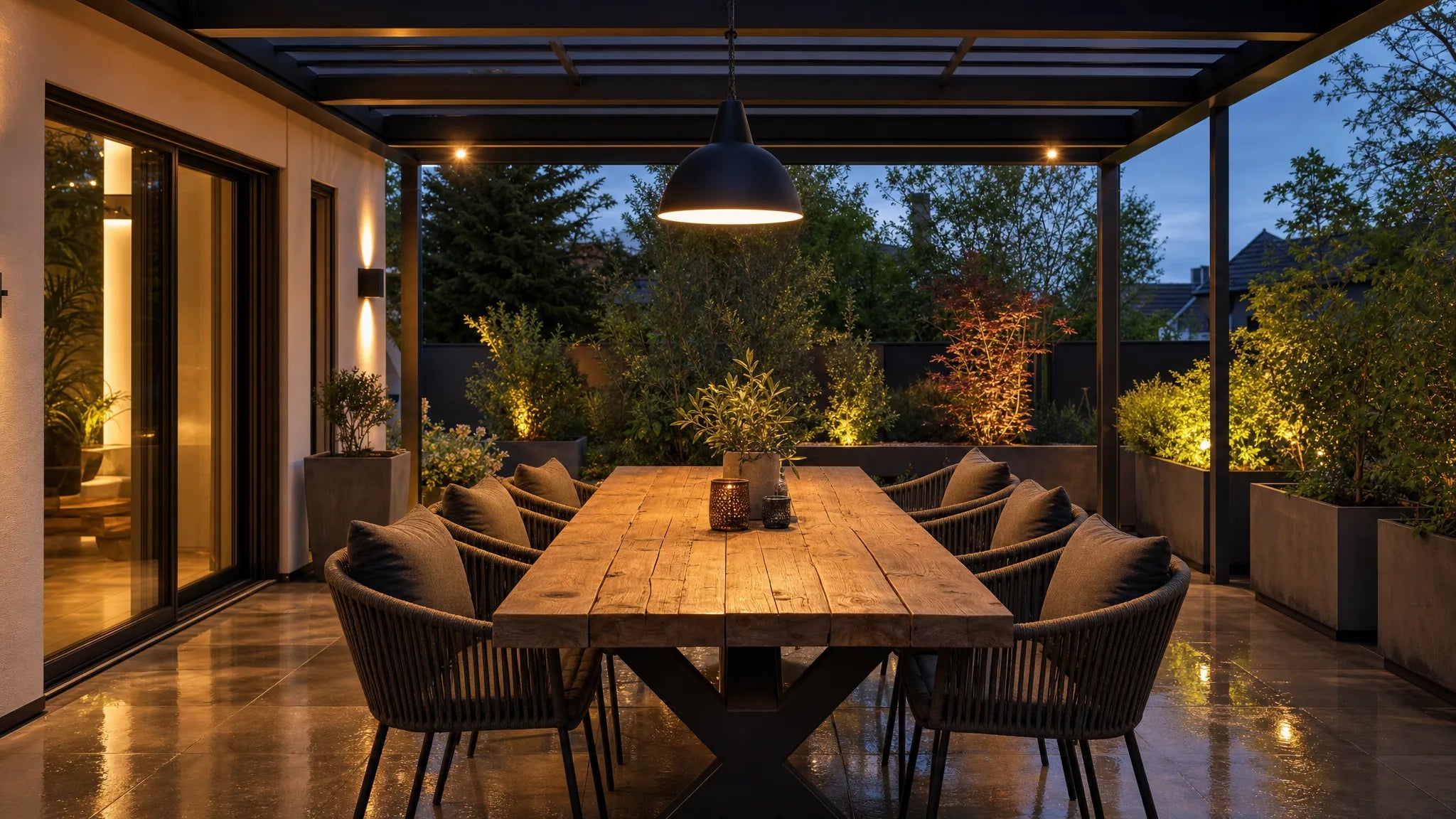
An outdoor one Pendant Lamp can immediately make the terrace, balcony or pergola appear more homely. It brings the feeling of a dining room outside, creates a clear zone above the garden table and creates atmosphere in the evening. At the same time, it is exposed to significantly greater loads outdoors than a pendant light in the living room: rain, splash water, condensation, wind, UV radiation, temperature fluctuations and dust have a lasting effect on the material, cable, socket and fastening.
With that one Pendant Lamp In order to not only look beautiful outside, but also function safely and for a long time, the protection class, installation location, material, electrical installation and suspension must all match. This guide shows what you should pay attention to when planning, purchasing and using.
Why an outdoor one? Pendant Lamp has special requirements
One Pendant Lamp outdoors is not just a normal pendant light with a nicer view. Outside, the stress changes fundamentally. Even under a covered patio roof, moisture can reach the light through fog, condensation, side rain or wet air. On open balconies there is additional wind movement, dust, pollen and temperature jumps.
The combination of moisture and electricity is particularly critical. Water can penetrate connections, metal parts can corrode and unsuitable cable insulation can age faster due to UV light or cold. The following applies: Only lights that are expressly suitable for outdoor use and have an appropriate IP protection rating should be used outdoors.
The design also plays a role. An outdoor one Pendant Lamp hangs freely in the room, unlike a wall or ceiling light. This makes them attractive in terms of design, but also more sensitive to wind and mechanical stress. The longer the suspension, the more important secure attachment, strain relief and a stable mounting point become.
The right IP protection class for hanging lamps outside
The IP marking describes how well an electrical device is protected against solid foreign objects and water. The first digit stands for protection against contact and dust, the second digit for water protection. The second digit is particularly important for outdoor lights because rain, splashing water and moisture pose the greatest risks.
You can also find a detailed basis on types of protection in BUYnBLUE-Guide Outdoor lamp: IP44 vs. IP65 clearly explained. For hanging lamps, however, it is important to take a closer look at the specific installation location.
| Location | Typical load | Useful minimum IP protection rating | Recommendation |
|---|---|---|---|
| Covered terrace, well protected | Damp air, occasionally splashing water | IP44 | Sufficient for many protected areas |
| Balcony with side rain | Splash water, wind, dust | IP54 or IP65 | Depending on the exposure, it is better to choose higher |
| Pergola with partial opening | Rain coming from multiple directions | IP65 | Recommended when the weather is unclear |
| Open outdoor area without a roof | Direct rain, dust, strong humidity | IP65 or higher | Only use outdoor lights approved for this purpose |
| Near pool, fountain or irrigation | Splash water, increased humidity | IP65 or higher | Distance and electrical planning are particularly important |
IP44 means protection against foreign bodies from 1 mm and splash water from all directions. This can be suitable for a covered terrace if the light is not directly rained on. IP65 offers dust tightness and protection against water jets. This type of protection is significantly more robust and is often the safer choice when side rain, sprinklers, open pergolas or windy balconies play a role.
Important: A higher IP protection rating does not replace professional installation. If a light is connected incorrectly, the canopy is poorly sealed or the cable is subjected to mechanical stress, even a generally suitable outdoor light can have problems.

Check the installation location first: protected does not automatically mean dry
Before you have an outdoor Pendant Lamp you should realistically assess the installation location. Many areas appear protected at first glance, but are only partially protected in everyday life. A roof overhang keeps out vertical rain, but not sideways rain. A pergola provides shade, but is often not waterproof. A balcony above provides protection, but it can still get wet in wind or heavy rain.
Before you buy, ask yourself these questions:
- In strong winds, will rain come to the planned position of the light?
- Can water run along the ceiling and toward the canopy?
- Will the light be hit by sprinklers, garden hoses or pool water?
- Is the area heavily exposed to wind?
- Is there enough headroom under the light?
- Is there a fixed, stable mounting point?
Especially on terraces it is worth observing after a rain shower. Where the ceiling or substructure remains damp, a luminaire with a higher protection class and particularly careful sealing should be chosen.
Choice of material: weatherproof also means corrosion-resistant
In addition to the IP protection class, the material determines the service life. Outdoor lights not only have to withstand water, but also UV radiation, temperature fluctuations and air pollutants. Corrosion can occur more quickly near the coast or on busy roads.
Suitable materials for outdoor hanging lamps include powder-coated aluminum, stainless steel, specially treated metals, weatherproof plastics and glass. It's not just the base material that's important, but also the workmanship: clean seals, protected screws, UV-resistant cables and a socket that's designed for outdoor conditions.
With glass, you should pay attention to a construction in which water does not collect. Shapes that are open at the bottom or are well drained are often more practical outside than umbrellas in which moisture can remain. With opal or satin glass, it is also important that they are easy to clean because pollen, dust and insect residue become visible more quickly outdoors.
Fasten securely: pay attention to weight, wind and strain relief
One Pendant Lamp outdoors moves more than an indoor light. Even a light wind can pull on the cable, chain or pendant rod. This movement increases on long suspensions. Therefore, the fastening must match the luminaire and the ceiling construction.
Different requirements apply to solid concrete ceilings, wooden beams, metal structures or patio roofs. It is important that the lamp not only supports its own weight, but also additional forces caused by wind movement. Professional fastening, suitable dowels or screws and effective strain relief are therefore mandatory.
For longer pendulums, a chain, a steel cable or a rigid pendulum rod can make more sense than a freely swinging cable alone. In windy areas the suspension should be chosen to be shorter. If a light sways strongly with every gust of wind, this will put long-term strain on connections, seals and fastening points.
Outdoor electrical systems: better to have them professionally planned
Outdoor electrical work should be carried out by a qualified electrician. This is particularly true when new cables are laid, existing connections are changed or lights are permanently connected to the power grid. Moisture, grounding, residual current protection, cable type and sealing must match.
In Germany, residual current protective devices (FI/RCD) with 30 mA are a central safety component for many external circuits. In addition, cables, junction boxes, terminals and switches must be suitable for the respective outdoor area. A luminaire with the appropriate IP protection class is of little use if the junction box is not weatherproof or the cable entry remains open.
If you are unsure, read this additionally BUYnBLUE-Contribution Installing lamps correctly: A short guide. However, the following always applies to outdoor areas: If there are fixed connections, damaged cables, moisture in the connection or unknown wiring, a specialist company should take over.
The right height for terraces, balconies and outdoor dining areas
The height of an outdoor Pendant Lamp decides on comfort and safety. If it is mounted too low, it will interfere with getting up, serving or walking through. If hung too high, it loses its zoning effect and dazzles at an unfavorable angle.
Above an outdoor dining table, a lower edge about 75 to 90 cm above the table top is often comfortable. This means that eye contact remains free, the light hits the table in a targeted manner and the lamp does not become an obstacle. For very large umbrellas, low ceilings or areas prone to wind, a slightly higher or shorter suspension may make sense.
There should be enough headroom under the luminaire in passage areas. As a guideline, a clear height of at least 210 cm applies, preferably more if large people, steps or moving areas are involved. On balconies and small terraces, a compact outdoor pendant light that hangs close to the ceiling is often more practical than a very long suspended model.
| situation | Recommended orientation | Why it makes sense |
|---|---|---|
| About outdoor dining table | approx. 75 to 90 cm above the table top | Good table lighting without a visual barrier |
| About lounge table | rather higher and less glare | More freedom of movement in the seating area |
| In walking paths | at least approx. 210 cm headroom | Avoids bumping and tripping hazards |
| Windy terrace | as short a suspension as possible | Reduces swing and material stress |
| Low balcony | compact Pendant Lamp or short commute | Looks homely without losing room height |
An advantage at BUYnBLUE is the free adjustment of many chandeliers and pendant lights, for example in terms of cable length, canopy or color. Especially outdoors, a suitable cable length can be crucial so that the light does not hang too low or has to be temporarily shortened. What remains important is that the model selected must generally be suitable for outdoor use.
Light quality: warm, low-glare and directed downwards
Outdoors is not just about brightness. A good outdoor Pendant Lamp is intended to create atmosphere, illuminate faces pleasantly and make the table visible without blinding neighbors, guests or the surroundings.
Warm white light is usually most pleasant for terraces and balconies. 2,700 to 3,000 Kelvin goes well with wood, natural stone, plants and textiles. If you want to attract less insects and reduce light pollution, choose warm, muted light and avoid unnecessarily high levels of brightness. The Federal Environment Agency points out that artificial light at night can have an impact on people, animals and the environment.
For an outdoor dining table, a downward-directed, shielded light distribution is particularly pleasant. Opal glass, diffusers or shades with concealed bulbs reduce glare. Dimming is also helpful outside: it can be brighter when eating, but later soft mood lighting is often sufficient.
Weatherproof details that are often overlooked
Many problems arise not from the luminaire itself, but from small details in connection and installation. A poorly fitting canopy, an unsuitable screw or an unprotected cable outlet can allow moisture to penetrate over the long term.
Pay particular attention to these points:
- The canopy should fit neatly on the ceiling and match the protection class.
- Cable bushings need suitable seals or screw connections.
- Screws and fasteners should be rust resistant.
- Cables must not be under tension or rub against sharp edges.
- The light should be mounted so that water does not run towards the connection.
- The lamp and socket must be suitable for the lamp and the outdoor area.
With pendant lights, it is also important that no water line runs directly along the cable into the canopy. A properly planned connection prevents moisture from getting into electrical components.
Care and maintenance: small control, big effect
Weatherproof outdoor lights should also be checked regularly. It's worth taking a quick look at the fastening, seals and surface, especially after storms, periods of frost or heavy rain. Moving hanging lamps can become slightly loose over time, especially if they are exposed to wind.
Clean glass and metal surfaces with a soft cloth and mild detergent. Aggressive cleaners, scouring pads or high-pressure cleaners are unsuitable for lights because they can damage seals or force water into sensitive areas. If there is visible moisture inside, flickering light, corrosion on electrical parts or damaged cables, the lamp should not be operated until it has been checked by a specialist.
Common mistakes when using an outdoor Pendant Lamp
The most common mistake is using an indoor light outdoors. Even if the light is hanging under a roof, it is not automatically protected enough. Condensation and temperature fluctuations are enough to put strain on unsuitable materials and frames.
A second mistake is hanging too long in windy areas. What looks elegant in the showroom can quickly become restless outside. The luminaire vibrates, may hit components or put permanent strain on the connection.
Light that is too bright or undirected is also problematic. A terrace should look inviting, not like a parking lot. Anti-glare shades, warm light color and dimmability create more comfort than maximum brightness.
Finally, the connection point is often underestimated. A high-quality outdoor light needs an equally suitable electrical connection. If the canopy, socket or cable are not weatherproof, a weak point arises.
Short purchase checklist before making a decision
Before you have an outdoor Pendant Lamp If you buy, these points should be clarified:
- Installation location: covered, partially protected or open?
- Protection class: at least IP44 in the protected area, more likely IP65 under heavier loads?
- Material: corrosion-resistant, UV and weatherproof?
- Suspension: short enough for wind and high enough for headroom?
- Lighting effect: warm white, low-glare, ideally dimmable?
- Connection: weatherproof supply line, suitable socket, FI/RCD and professional installation?
- Care: Is the light easily accessible for cleaning and checking?
- Design: does the shape and size match the terrace, the table and the architecture?
Once these questions have been answered, it will be much easier to choose the right lamp. Especially with special dimensions, high patio roofs or offset connections, adjusting the cable length or canopy can make the difference between a compromise and a harmonious solution.
Frequently Asked Questions
Can I have a normal one? Pendant Lamp use outside under a roof? No, not without express approval for outdoor use. Even under a roof, moisture, condensation and temperature fluctuations affect the luminaire. Only use models with a suitable IP protection class and suitable materials.
Which IP protection class does an outdoor need? Pendant Lamp at least? In well-protected areas, IP44 is often a sensible minimum orientation. For side rain, open pergolas, windy balconies or close to water, IP65 is usually the more robust choice.
How deep should an outdoor one be? Pendant Lamp hanging over the dining table? A distance of around 75 to 90 cm between the table top and the lower edge of the lamp is suitable as a guide. What is important is a clear view, sufficient headroom and a suspension that does not swing strongly in windy conditions.
Must have an outdoor one Pendant Lamp be installed by an electrician? For permanently connected outdoor lights, a qualified electrician is strongly recommended. Moisture, residual current protection, cable type, sealing and secure fastening must be carried out professionally.
Which light color is pleasant for the terrace and balcony? Warm white light between around 2,700 and 3,000 Kelvin looks homely and goes well with outdoor areas. A dimmable solution can be useful for a particularly quiet evening atmosphere.
Conclusion: Plan for the weather, then enjoy it comfortably
An outdoor one Pendant Lamp is ideal if the terrace, balcony or pergola should not only be illuminated, but should also appear like a real living area. But it only becomes safe when the protection class, installation location, material, suspension and electrical system match.
At BUYnBLUE You will find a curated selection of high-quality designer lights and can have many pendants and chandeliers adjusted free of charge, for example in terms of cable length, canopy or color. This means that the lamp can be better adjusted to the room height, table position and architecture. For outdoor projects, always check the suitability for the respective location and have fixed outdoor installations professionally installed. Then your outdoor will be Pendant Lamp Not just an eye-catcher, but a safe, long-lasting lighting solution for many evenings outside.