Pendant Lamp Plan your dining room so that it is glare-free and harmonious
One Pendant Lamp In the dining room, it's not just a matter of whether the table is bright enough. It shapes the line of sight, the atmosphere while eating and often the first impression of the entire living area. Well planned, it seems natural: the light falls pleasantly on plates and faces, no one looks directly into bright LEDs, and the size, material and height of the lamp fits the room.
The most common mistake is to choose the lamp based solely on design. Especially in the dining room, it has to fulfill several tasks at the same time: It should zone the table, make food appear appetizing, accompany conversations pleasantly and, if necessary, be bright enough for homework, games or home office at the dining table. Freedom from glare and harmonious proportions are therefore not details, but rather the basis of good planning.
First plan the table, then the lamp
The most important rule is: The Pendant Lamp depends on the dining table, not on the geometric center of the room. In many apartments, the ceiling outlet is not exactly above the table because furniture has been placed differently over the years or the floor plan is open. However, the table area is what counts for the effect in everyday life.
Therefore, first measure the table and its real position in the room. The decisive factors are length, width, table shape, seating, pull-out function and the distance to walls, sideboards, kitchen islands or walkways. Only then can it be judged whether a single pendant light is a linear one Pendant Lamp, several small pendants or a light chandelier are useful.
| Planning point | Why it is important | Practical tip |
|---|---|---|
| Table shape | Determines the shape and arrangement of the lamp | Round tables appear calmer with a central light, long tables often appear with a linear solution |
| table length | Prevents lights that are too small or too dominant | Usually choose a lamp that is significantly shorter than the table |
| Ceiling height | Affects suspension and line of sight | For low ceilings, prefer flatter, diffuse shapes |
| Seating positions | Decide about glare | From every sitting position, check whether lamps are visible |
| Ceiling outlet | May deviate from ideal center | If necessary, plan for a canopy, decentralized suspension or adjustment |

The right height: low enough for atmosphere, high enough for eye contact
For most dining rooms, a lower edge of the light works 60 to 75 cm above the table top. This area is low enough to mark the table as its own island of light, but high enough so that you can clearly see the person opposite you. For very tall people, particularly voluminous umbrellas or transparent lights, a little more distance may make sense.
It's not just the tape measure that's important, but the line of sight. Sit in several places and check whether the light is covering the other person's face or whether you are looking directly into the light source. A lamp can be present, but it should not visually disrupt conversations.
In very high rooms the opposite error often occurs: The Pendant Lamp is mounted too high because you want to emphasize the height of the ceiling. Then the table loses its security and the light is distributed too much throughout the room. A deliberately lower suspension above the table is better, combined with additional room lighting on the wall, ceiling or sideboard.
Size and shape: that's how it works Pendant Lamp harmonious in the dining room
The lamp should be smaller than the table, but large enough not to appear lost. As a simple guide, stay with elongated lights Left and ideally a visible edge to the right of the table edge. With round or organic shapes, the mathematical length is less important than the optical mass.
A very delicate lamp can be a little larger because it has less volume. A black, solid or highly sculptural one Pendant Lamp On the other hand, it becomes dominant more quickly. In small dining rooms, light shapes, glass, opal surfaces or narrow metal lines are often more pleasant than heavy shades.
| Dining table | Suitable lighting idea | What to pay attention to? |
|---|---|---|
| Round, 90 to 120 cm | A central pendant light or compact chandelier | Place the lamp in the middle, do not choose a diameter that is too massive |
| Oval or round, larger than 120 cm | Multi-bulb lamp or wide, soft shape | Distribute light evenly, not just illuminate the center of the table |
| Rectangular, 160 to 200 cm | Linear Pendant Lamp or two pendulums | Align the lamp along the table axis |
| Long, from 220 cm | Long pendant light or three pendants in a row | Do not leave edge zones dark, plan distances evenly |
| Extendable table | Flexible, longer light distribution | Plan for the most common table size and use dimmability |
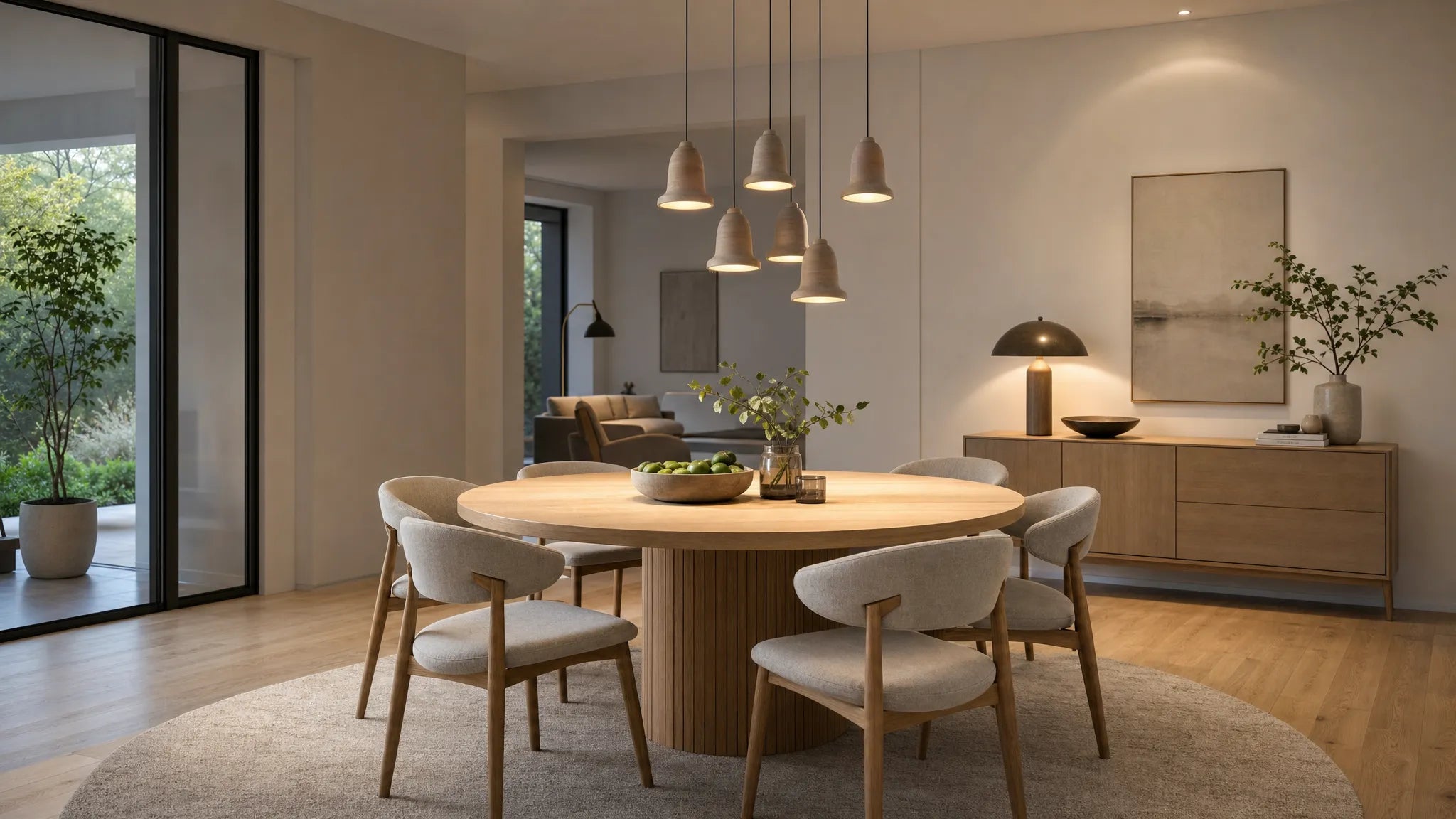
It looks particularly harmonious when the shape of the lamp follows the shape of the table without rigidly copying it. A round table tolerates round, oval or organic lights. A long table appears very calm with a linear lamp, but can also be made more lively with several individual pendants.
Freedom from glare comes from shielding, not from less light
Many dining rooms are not too bright, but rather the wrong kind of light. Glare occurs when the eye looks directly into an intense light source or when shiny surfaces reflect the light unpleasantly. A dimmable light source alone does not solve the problem if the LED remains visible from seat height.
Glare-free hanging lamps work with diffusers, deep shades, opal glass, textile materials or a construction that distributes the light softly downwards and to the sides. For open lights with visible bulbs, you should pay particular attention to matt or opal bulbs. Clear LED filament lamps can be decorative, but depending on the position they are more likely to cause glare.
| Type of luminaire | Blinding effect | Suitable for |
|---|---|---|
| Opal glass pendulum | Very soft and diffuse | Family dining rooms, open living areas, small spaces |
| Deep metal shade | Direct and well shielded | Tables that need to be specifically lit |
| Textile umbrella | Warm and homely | Classic, Scandinavian or calm interiors |
| Open filament light | Decorative but potentially dazzling | Rooms with dimming and conscious accent lighting |
| Multi-light chandelier | Atmospheric, very different depending on the umbrella | Larger dining rooms and high ceilings |
A good practical test: Sit at the table in the evening, switch the light to normal brightness and move your gaze from the plate to the person opposite. If you blink involuntarily, squint your eyes or see bright spots in your field of vision, the lamp is not sufficiently shielded or is hanging unfavorably.
Light color and brightness: warm, natural and flexible
Warm white light is usually the best choice for the dining room. 2,700 to 3,000 Kelvin appear inviting, make wood, textiles and wall colors appear pleasant and create a calm evening atmosphere. Cooler light can be useful in kitchen work areas, but quickly appears objective above the dining table.
In addition to the light color, color rendering is crucial. A high CRI or Ra value ensures that food, skin tones and materials appear natural. For living areas, a CRI of at least 80 is common, and for particularly high-quality dining area lighting CRI 90 or higher recommended.
When it comes to brightness, you shouldn't just think about watts. The decisive factors are lumens, light distribution and the actual level of illumination reaching the table surface. As a guide, around 150 to 300 lux on the table surface is suitable for the dining area. It can be brighter for games, reading or working, but significantly dimmed for dinner in the evening.
| Use at the dining table | Light effect | Recommendation |
|---|---|---|
| Dinner | Warm, soft, communicative | 2,700 to 3,000 K, dimmed |
| Everyday family life | Uniform and sufficiently bright | Glare-free lamp with light reserve |
| Work or homework | Brighter and more concentrated | Additional light source or stronger dimming upwards |
| Guests and dinner | Atmospheric, not too flat | Dimmer, possibly additional wall lights or sideboard light |
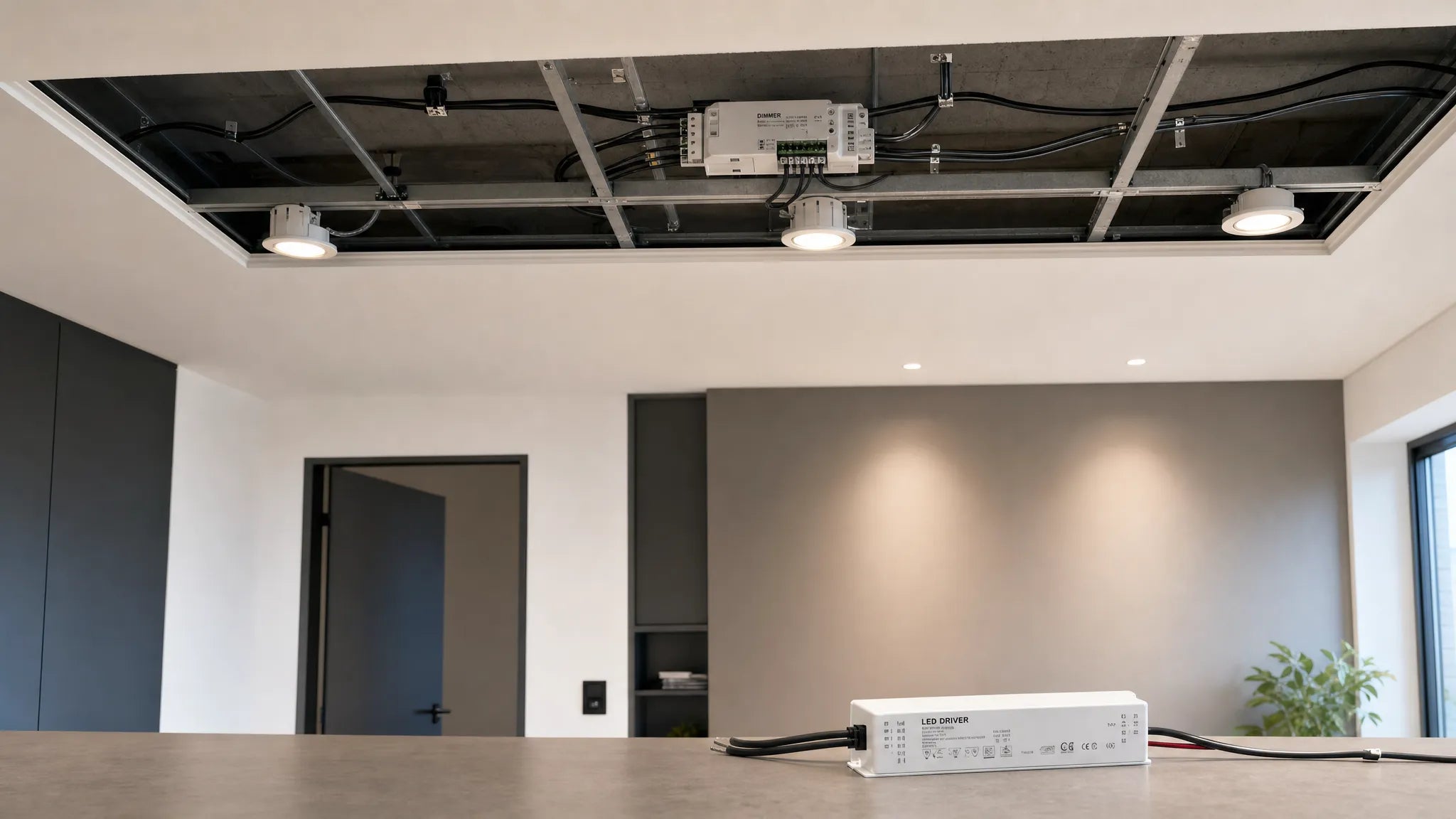
Dimmable light is particularly valuable in the dining room because the table rarely has only one function. But make sure that the LED, driver and dimmer fit together. If you would like to know more about flicker-free solutions, see the BUYnBLUE-Guide to Dimming LED lamps additional technical information.
Positioning with offset ceiling outlet
An off-center power connection is no reason to hang the lamp incorrectly over the table. Especially in renovated apartments, old buildings or open kitchen-dining areas, the outlet is often in a place that matched the original furniture, but no longer fits.
There are several clean solutions. A larger or specially adapted canopy can conceal the connection. A decentralized suspension guides the cable to the correct position in a visually organized manner. For larger projects, an electrical contractor can also relocate the outlet or plan a rail system.
It is important to think about the solution early on. A perfectly selected designer lamp appears restless if it ends up hanging visibly at an angle to the table or if the cable is routed in an improvised manner. BUYnBLUE offers free customization for pendant lights and chandeliers, for example in terms of cable length, canopy or color. This is particularly helpful if the ceiling height, table position or room layout differs from the standard.
Material and color: the lamp should connect the room
A harmonious dining room light does not have to match the table top, chair legs or kitchen handles exactly. A room often appears to be of higher quality if materials are deliberately related but not identical. It is crucial that the lamp relates to at least one element in the room.
Black metal can accommodate chair frames, window frames or kitchen fronts. Brass or gold tones harmonize well with warm wood, natural stone and beige wall colors. Opal glass appears calm and timeless, especially if the room contains a lot of textures. Wood, rattan, paper or linen create warmth, but for very rustic tables they should deliberately have a modern shape so that the overall look is not heavy.
In open living-dining areas, restraint is often the better strategy. If the sofa, carpet, kitchen and art already have a strong effect, this can be done Pendant Lamp Clearly mark the dining area without dominating the room. In very reduced rooms, however, it can be the central design element.
More light sources instead of an overwhelmed lamp
One Pendant Lamp Above the dining table is the focal point, but rarely the only source of light a dining room needs. If it has to provide table lighting, room lighting, accent lighting and mood lighting at the same time, compromises arise. Most of the time it is either too bright and blinding, or it is atmospheric but the rest of the room remains dark.
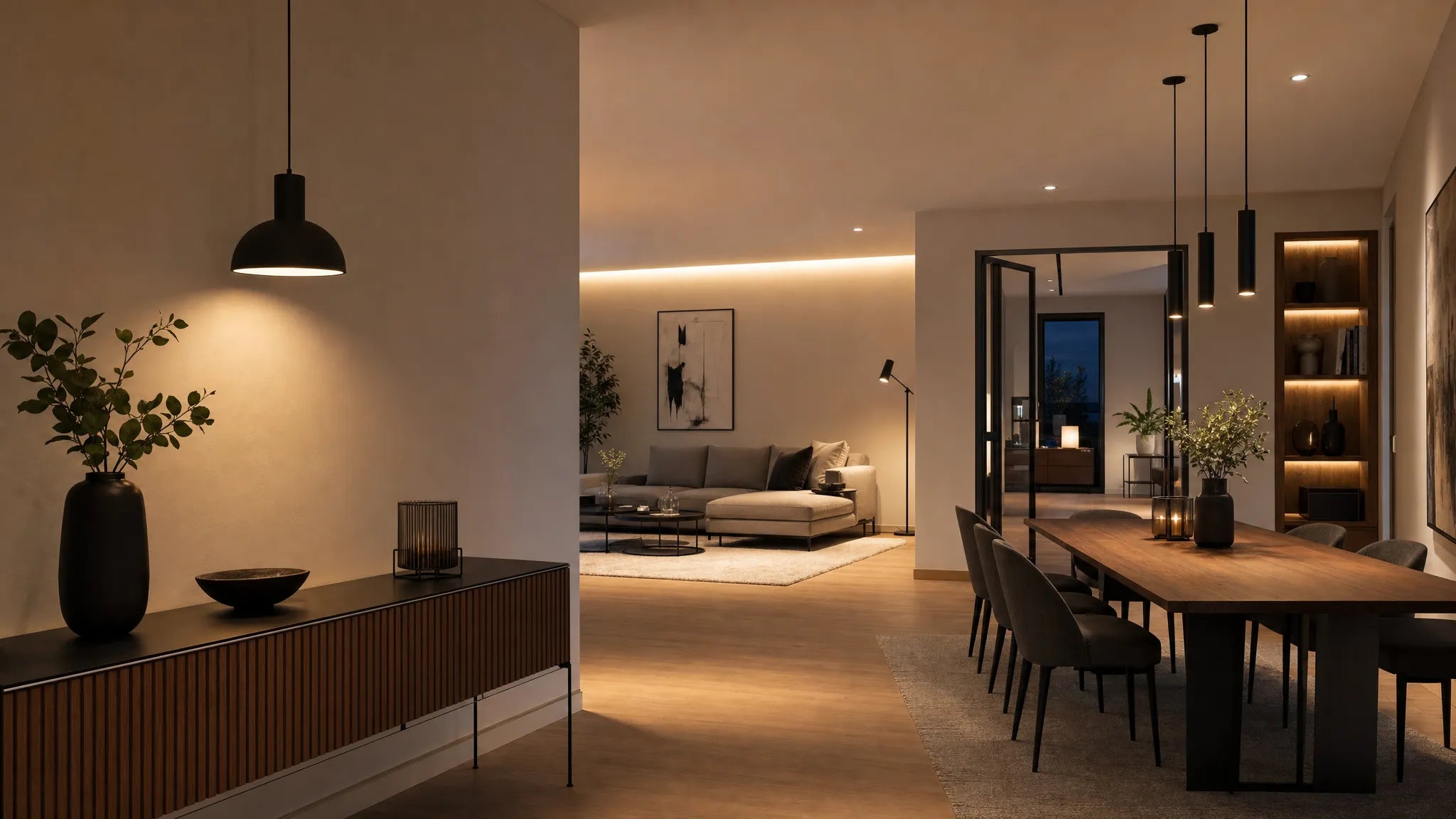
So plan in layers. The Pendant Lamp takes over the table zone. A wall light, a sideboard light or indirect ceiling lighting complements the room. In open floor plans, the kitchen lighting can also be switched separately so that the bright work lighting does not dominate while eating.
This layering of light has a particularly high-quality effect because it creates depth. The table is visibly the focal point, but the surroundings do not fall into harsh darkness. This is easier on the eyes and makes the room inviting even when the table is not set.
Short planning checklist before purchasing
Before you choose one Pendant Lamp If you decide, it's worth a final reality check. It prevents bad purchases that look nice in product pictures but don't work in your own room.
- Measure table length, table width and ceiling height.
- Align the lamp position with the table, not just with the ceiling outlet.
- Test the lower edge of the lamp with string or cardboard at 60 to 75 cm above the table.
- From every sitting position, check whether lamps or LED points are directly visible.
- Choose a light color of 2,700 to 3,000 K and the highest possible CRI.
- Clarify dimming and dimmer compatibility before purchasing.
- Connect material and color to at least one element in the room.
- If you have special dimensions, have the cable length, canopy and finish adjusted in good time.
The following applies to electrical work: If connections are changed, ceiling outlets are moved or heavy lights are installed, a specialist should be involved. You can also find basic safety instructions in BUYnBLUE-Contribution Install lamps correctly.
Frequently asked questions about Pendant Lamp in the dining room
How high should one be? Pendant Lamp hanging over the dining table? A distance of 60 to 75 cm between the table top and the lower edge of the lamp usually works as a guide. For very tall people, large umbrellas or transparent lights, a little more distance may be more pleasant.
Which light color is ideal in the dining room? For most dining rooms, 2,700 to 3,000 Kelvin is ideal. The light appears warm, homely and makes food and materials appear natural.
How do I avoid glare at the dining table? Choose a lamp with a diffuser, opal glass, deep shade or shielded LED. Also check from seat height whether you are looking directly into the light source. Dimming helps, but is no substitute for good shielding.
Should that Pendant Lamp Hang in the middle of the room or in the middle above the table? It should hang in the middle above the table. The dining table is the functional and visual zone on which the lamp is oriented. An offset ceiling outlet can often be solved with a suitable canopy or adapted cable routing.
Which Pendant Lamp fits a long dining table? Long dining tables usually look harmonious with a linear pendant light or several pendants in a row. It is important to have an even distribution of light over the length of the table, without the lamp reaching the edges of the table.
Is a dimmable one Pendant Lamp useful in the dining room? Yes, because the dining table is often used for eating, working, playing and entertaining. With dimming, the same lamp can appear bright and practical or warm and atmospheric.
Plan the dining room light appropriately and adapt it individually
If one Pendant Lamp If you want the dining room to really look harmonious, the design, height, light distribution and room dimensions must all fit together. This is exactly where a lamp that not only looks beautiful but can be adapted to your room is worth it.
At BUYnBLUE you will find a curated selection of modern designer lights for dining rooms, living areas and open floor plans. Many pendant lights and chandeliers can be customized free of charge, for example in terms of cable length, canopy or color. Plus free worldwide shipping, secure payment options, real-time tracking and a 14-day return policy. This means that your dining room lighting can be planned not only according to style, but also according to the logic of the room.