Use hexagon light in a modern way without a gaming look
Hexagon light has acquired a clear image in recent years: glowing honeycombs on the wall, RGB colors, streaming setup, gaming room. This can work, but it is by no means the only way to use hexagonal lights.
In modern living spaces, the hexagon shape has a particularly strong effect when it is not seen as an effect but as an architectural design element. A hexagon brings structure to the room without appearing as strict as a square. It's geometric but softer. Concise, but not automatically loud.
The difference between stylish and “too gaming” lies primarily in five things: material, light color, proportion, placement and combination with other lights.
Why hexagon light quickly looks like gaming
The gaming look is rarely created solely by the hexagonal shape. It is usually the sum of several signals that makes the room appear technical, colorful or restless.
Typical triggers are very cool light colors, visible RGB color changes, many small modules on a wall, strong contrasts between dark walls and bright lights, and shiny plastic surfaces. A honeycomb surface that is too symmetrical can quickly appear like a decorative panel instead of deliberately planned lighting.
For living rooms, dining areas, hallways or high-quality renovation projects, restraint is therefore crucial. Hexagon light shouldn't look like it was added later as a gadget. It should appear as if it were part of the architecture of the room.
The modern interpretation: geometry instead of effect
A modern hexagon light doesn't have to be colorful, modular or playful. It can make a quiet statement, much like a linear pendant light or a sculptural chandelier. What is important is that the form fulfills a task.
Above a dining table, a hexagon can define the table zone. In a high entrance area it can create volume and eye guidance. In a living room, it can create a clear center when furniture, carpet and lamps are coordinated.
Instead of asking “How noticeable can the lamp be?”, the better question is: “What role should the hexagon shape play in the room?” Should it be a focal point, a graphic addition or a subtle repetition of existing lines?
Materials that avoid the gaming look
Material is one of the strongest style filters. The same hexagon shape can appear futuristic, homely, elegant or cool, depending on how the surface and light emission are designed.
The following are particularly suitable for an adult, modern look:
- Matte metal finishes in black, white, champagne, brass or brushed nickel
- Opal or satin diffusers that distribute the light softly
- Slim profiles instead of bulky plastic frames
- Warm, reserved surfaces in combination with wood, natural stone or textile
- Clear lines without visible cables, bright color zones or overloaded patterns
Shine does not necessarily have to be avoided. A polished detail can appear high-end if the rest of the room remains calm. It only becomes a problem when shiny surfaces, strong LED edges and strong colors occur at the same time.
The right light color: warm, clear and homely
Light color has a strong influence on whether a hexagon light appears cozy or technical. Warm white light is usually the safest choice for living rooms, bedrooms and dining areas. Values around 2700 to 3000 Kelvin appear pleasant, inviting and of high quality.
In kitchens, work areas or hallways, slightly more neutral light can be useful, for example in the 3000 to 4000 Kelvin range. It is crucial that the light color matches the purpose of the room. A dining room with very cool light quickly appears uncomfortable, while a work area with too warm light can sometimes make you tired.
If possible, it is also worth taking a look at the color rendering. A high color rendering index, often stated as CRI or Ra, makes wood, fabrics, wall colors and food appear more natural. This is an important difference, especially when it comes to designer lights and high-quality interiors.
| space | Recommended lighting effect | What you should avoid |
|---|---|---|
| Dining room | Warm white, dimmable, focused on the table | Too bright, cold white light directly in the face |
| Living room | Soft basic light plus accent light | A single very bright hexagon area as the main light |
| hallway | Clear orientation, uniform brightness | Dark corners and blinding points of light |
| bedroom | Warm, indirect, calm | Color changes and hard contrasts |
| Kitchen | Neutral to warm white, low-glare, functional | Shadows on work surfaces and shiny glare |
Hexagon light in the dining room: the most elegant field of application
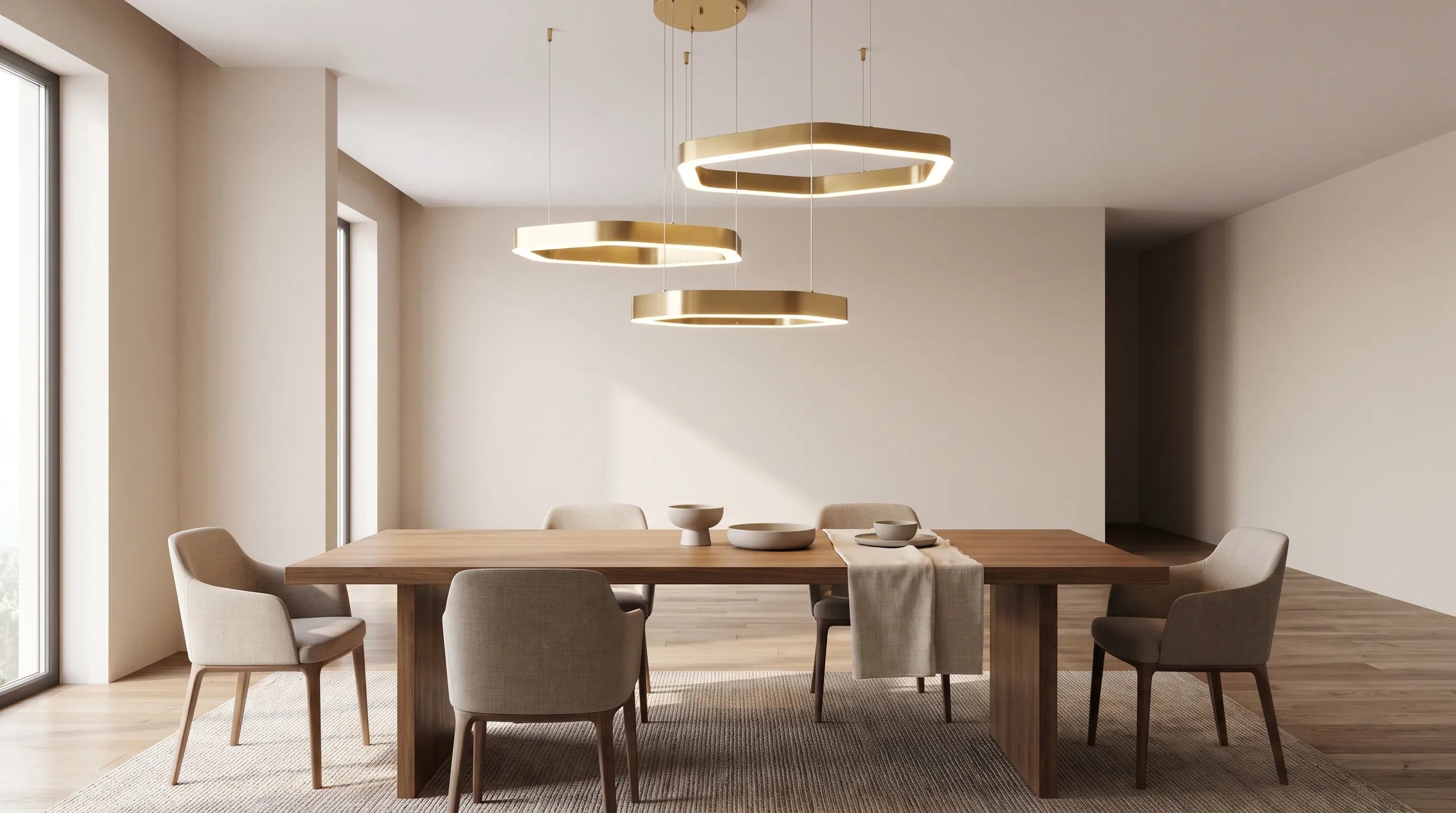
The dining table is often the best place for a modern hexagon light. A lamp can be visible here because it not only provides light, but also marks the center of the room. The hexagonal shape brings a special tension: it is more graphic than a round lamp, but less strict than a rectangle.
The right size is important. A lamp that is too small will lose its effect over a large table. A lamp that is too large can dominate the dining area. As a guide, the lamp should remain significantly smaller than the width of the table and leave enough distance to the table edges.
The suspension height also counts. A pendant lamp usually looks harmonious above the dining table if it hangs low enough to create atmosphere, but high enough not to disturb eye contact. For high ceilings or open floor plans, customized cable length can be crucial.
This is exactly where a lamp like the Hexagon designer pendant lamp fits particularly well into the concept: it uses the hexagonal shape as a conscious design statement, not as a wall gadget. It can elegantly translate the geometric idea for modern dining areas, open kitchens or representative living areas.
Living room: it's better to have one strong object than many small modules
In the living room, hexagon light works best when it doesn't occupy the entire wall. Many small, glowing honeycombs quickly remind you of setup lighting or decorative panels. A single, strong lighting object or a reduced group that works with the furniture concept is more elegant.
An example: Above a coffee table or in the middle of a seating area, a geometric lamp can define the room zone. Wall or floor lamps, which provide softer light, go well with this. This creates depth instead of a single element visually dominating the room.
If you want to combine several light sources, you should use recurring features. This can be a common metal color, similar lines or a uniform light color. Further basic rules for this can be found in BUYnBLUE Guide on the topic Combine modern lamps harmoniously.

Hallway, staircase and entrance area: graphic, but not loud
Hexagon light can have a particularly high-quality effect in transition zones. Hallways, stairwells and entrance areas benefit from clear shapes because these rooms often have little furniture. A geometric lamp provides structure without requiring a lot of space.
Here you should pay particular attention to glare. Anyone who sees a light from below, from the stairs or from several angles will quickly perceive hard points of light as annoying. Diffused light, good shielding and a suitable mounting height are therefore more important than maximum brightness.
For low ceilings, a flatter lamp shape is often better. If the ceiling is high, the luminaire may have more volume. In a two-story entrance area, a hexagon can even appear like a sculptural element if it is neatly coordinated with axes, doors and walkways.
Kitchen and home office: function over form
In the kitchen and home office, hexagon light can appear more modern and technical, but not become impractical. The form should support the function. A hexagonal pendant light can work very well above a kitchen island if it provides enough working light and is not blinding.
When working from home, restraint is even more important. A conspicuous light in your direct field of vision can be disruptive during video calls or concentrated work. It is better to have clear basic lighting, supplemented by a good task light. When a hexagon light is used, it should serve as a room accent or central ceiling light, not a garish background effect.
With LED lights, it is always worth asking whether the light is pleasant in everyday life. You can also find information about brightness, radiation and visual comfort in the article about Glare-free planning of modern LED ceiling lights.
Proportions: the most important difference between design and decoration
A geometric lamp is less forgiving of incorrect proportions than a simple round lamp. If a hexagon is too small, too high, too low, or misaligned, it will immediately stand out. That's why the lamp should always be planned in relation to the room.
Above a dining table it should match the shape of the table. On a round table, a hexagon can create an exciting contrast. On a rectangular table it works particularly well if the lamp is centered and has enough presence. In open living areas, it should also harmonize with the kitchen island, sofa, carpet or room axes.
For architects, interior designers and renovation projects, it is helpful to think about the luminaire early on in the floor plan and views. The connection point, cable length, canopy and line of sight can then be carefully coordinated. At BUYnBLUE The free adjustment of pendant lights and chandeliers, for example in terms of length, canopy or color, is particularly practical if the room height or layout does not correspond to the standard.
Color concept: Hexagon yes, RGB only very consciously
Color is not forbidden. But if you want to use hexagon light without a gaming look, you should use RGB effects very specifically. Permanent color changes, strong blue, violet or neon green immediately send a technical signal. This may be intentional in a media room, but rarely suits a formal living or dining area.
Instead, tonal concepts appear to be of higher quality. Warm white light on a lime plaster wall, a black lamp over light wood or a brass accent in a neutral room create much more depth than colorful effects.
If color is used, it is better to use it subtly: a warmer dimmed evening light, a slightly golden reflection or an accent wall in a calm tone. This means the hexagon remains a design element and does not become a light show.
How to combine hexagon light with other shapes
A room does not have to be completely geometric in design just because there is a hexagon lamp. On the contrary: the combination with softer shapes prevents the room from appearing too constructed.
A hexagonal light object harmonizes well with round coffee tables, organic armchairs, textile curtains or a soft carpet. In very minimalist rooms, however, it can be combined with linear furniture and clear edges. It is important that at least one element picks up on the design language without copying it.
Good combination partners are:
- Round or oval furniture that balances the severity of geometry
- Linear wall lights that support the modern character
- Textile shades or indirect light for more comfort
- Natural materials such as wood, stone or linen as a warm counterpoint
- Calm wall colors so that the lamp does not compete with the background
On the other hand, avoid too many geometric patterns at the same time. Hexagon lamps, honeycomb wallpaper, polygonal carpets and angular shelves can quickly appear over-staged together.
Common mistakes and better solutions
Many rooms appear problematic not because of the hexagon shape, but because of small planning errors. The following overview helps with quick classification.
| Error | Effect | Better solution |
|---|---|---|
| Too many glowing hexagon modules | Gaming or studio look | Choose a central design object |
| Cold light in the living area | Uncomfortable and technical | Use warm white, dimmable light |
| Visible cables or inappropriate canopy | Installed later | Plan cable length and ceiling termination |
| Lamp too small for the table | Lost and decorative | Adjust size to suit table and room volume |
| Just one light source in the room | Flat and unbalanced | Combine basic, accent and zone lighting |
Planning checklist for an elegant result
Before you buy or plan a hexagon light, it's worth doing a quick check. It prevents a good light from losing its effect in the wrong place.
- What task does the luminaire perform: focal point, accent or basic light?
- Does the size match the room height, table size and furniture?
- Is the light color comfortable enough for the respective room?
- Is the lamp perceived glare-free from a sitting or standing perspective?
- Are there other light sources that complement the hexagon light?
- Are the cable length, canopy and color coordinated with the room?
The last point in particular is often underestimated. A high-quality lamp only looks natural if it fits the room structurally and visually. Adjusting the length, color or canopy can therefore have more effect than a completely different model.
When hexagon light is particularly suitable
Hexagon light is ideal if you want a room to appear modern, but not arbitrary. It is suitable for people who like clear shapes but are not looking for purely technical or industrial solutions.
It goes particularly well with modern new buildings, renovated old apartments with a conscious break in style, open kitchens, dining areas, lofts and representative entrance areas. Even in projects with a reduced color palette, a hexagonal light object can set exactly the accent that gives the room character.
It is less suitable if there are already a lot of strong shapes in the room. Then the light should remain calm or the hexagon shape should be used very subtly.
FAQ: Use hexagon light in a modern way
Is Hexagon Light automatically gaming lighting? No. The gaming impression is created primarily by RGB colors, modular honeycomb surfaces, cool light colors and a plastic look. With high-quality materials, warm light and clear placement, Hexagon light can look very elegant.
Which light color suits hexagon light in the living room? For living rooms, 2700 to 3000 Kelvin are usually ideal. This looks warm, homely and less technical. If the lamp is dimmable, the mood can also be adjusted to the time of day and usage.
Does a hexagon lamp fit over a round dining table? Yes, the contrast between the round table shape and the hexagonal lamp can be particularly exciting. It is important that the lamp hangs centered and fits the table in size and hanging height.
How do I prevent glare from geometric LED lights? Pay attention to diffuse light surfaces, good shielding, appropriate mounting height and not too much brightness in the direct field of vision. Especially in hallways, stairs and dining tables, the lamp should be pleasant from multiple angles.
Can you combine hexagon light with classic lights? Yes, it can even seem very high quality. What is crucial is a unifying element, such as a common metal color, similar light color or a calm material palette.
Conclusion: Hexagon light looks modern when it is consciously planned
Hexagon light doesn't have to look like a gaming room. The hexagonal shape can look very elegant in modern living rooms, dining areas and entrance areas when used as part of a well-thought-out lighting concept.
The key is warm light, high-quality materials, appropriate proportions and a calm combination with other lights. Instead of many small effects, one strong, well-placed design object is often enough.
If you are looking for a geometric lamp that fits harmoniously into a modern interior, discover the curated selection of designer lighting at BUYnBLUE. With individual adjustment options, your light can be precisely tailored to the room height, ceiling connection and design concept.