Use RGB LED lamps correctly without losing coziness
RGB LED lamps can transform rooms: a warm amber glow in the evening, a gentle color fringe behind the sideboard or a subtle light accent on the shelf. At the same time, this versatility is precisely the reason why RGB lighting can quickly seem restless, cool or like a gaming room instead of a living room.
The key is not to avoid color. What is crucial is how dosed, where placed and with what basic light an RGB LED lamp is used. Coziness comes from balance: Color can create atmosphere, but should rarely take the lead role.
The most important basic rule: color is an accent, not a foundation
A comfortable room first needs pleasant basic lighting. This is usually warm white light that makes furniture, faces, textiles and surfaces appear natural. RGB lighting complements this foundation by creating depth, mood or an eye-catcher.
As a simple rule of thumb, a 70-20-10 principle works very well: most of the lighting remains functional and warm, a smaller part creates zones, and only a very targeted portion is colored.
| light proportion | task in the room | Recommendation for RGB |
|---|---|---|
| 70 percent basic light | Orientation, everyday life, uniform brightness | Warm white or neutral white, not RGB as the main source |
| 20 percent zone light | Reading, eating, working, accentuation | Dimmable lights, directed or indirect light |
| 10 percent color accent | Mood, depth, decorative scenes | RGB subtle, indirect and rather low saturation |
If you stick to this ratio, you avoid the most common mistake: an entire room is flooded with blue, red or violet and thereby loses its natural warmth. An RGB LED lamp appears particularly high-quality if it does not dominate like a light show, but rather supports architecture, furniture or materials.
Why RGB light can quickly seem uncomfortable
RGB stands for red, green and blue. Many shades can be created by mixing these three colors. This is ideal for moods and effects, but does not automatically replace good white light. Depending on the technology, pure RGB white can appear less natural than warm white LED light or RGBW light with an additional white channel.
RGB lighting usually becomes uncomfortable for three reasons. Firstly, the light source is directly visible and is blinding. Secondly, the colors are too saturated or too bright. Thirdly, there is no calm basic light that visually ties the room together.
If you want to understand more deeply how light color, dimming and LED technology work together, it's worth it BUYnBLUE-Guide to Advantages, light color and dimming of LED lamps. The following applies in particular to RGB: Technology is only beautiful if it remains pleasant in everyday life.
The best places for an RGB LED lamp
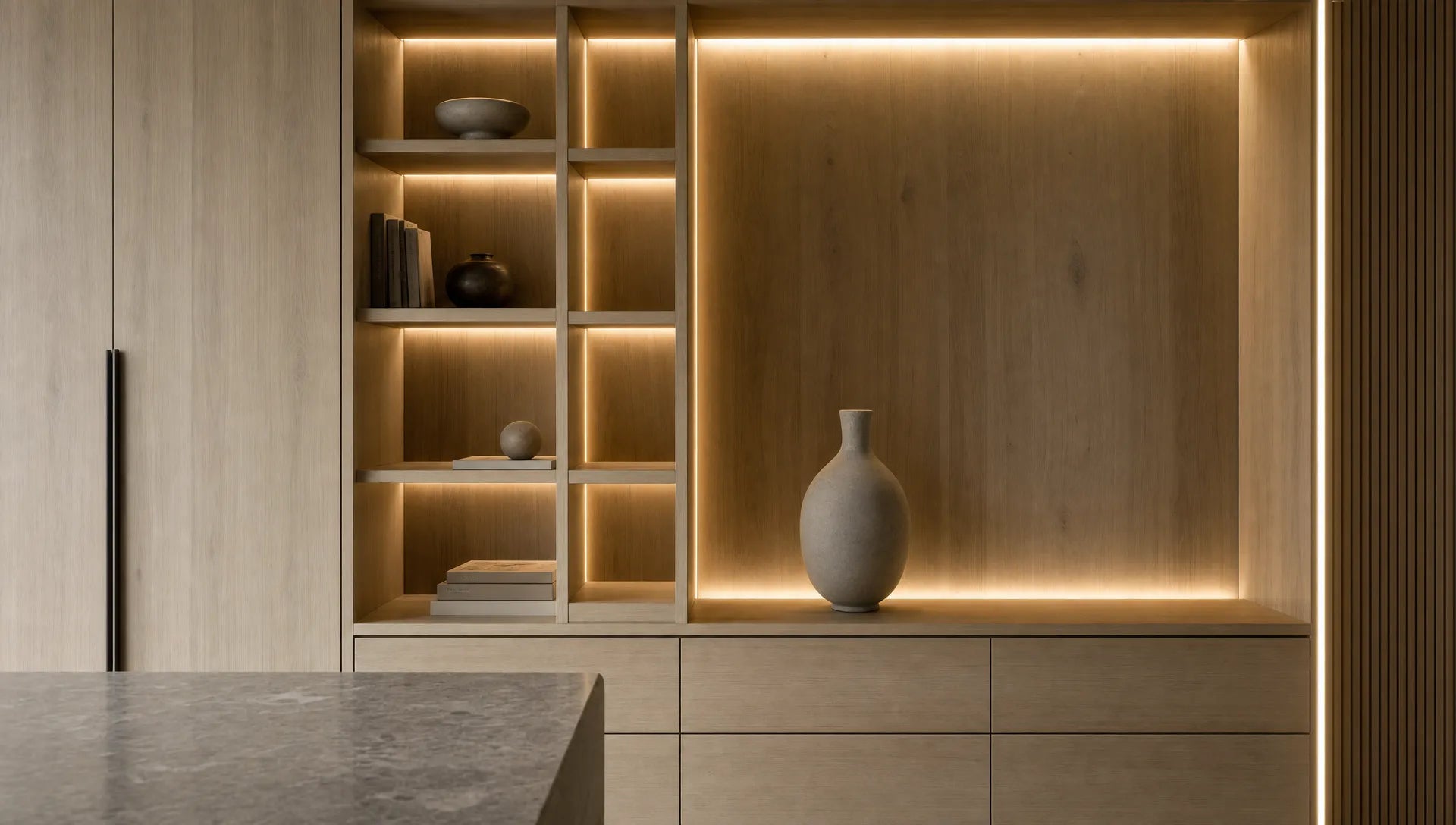
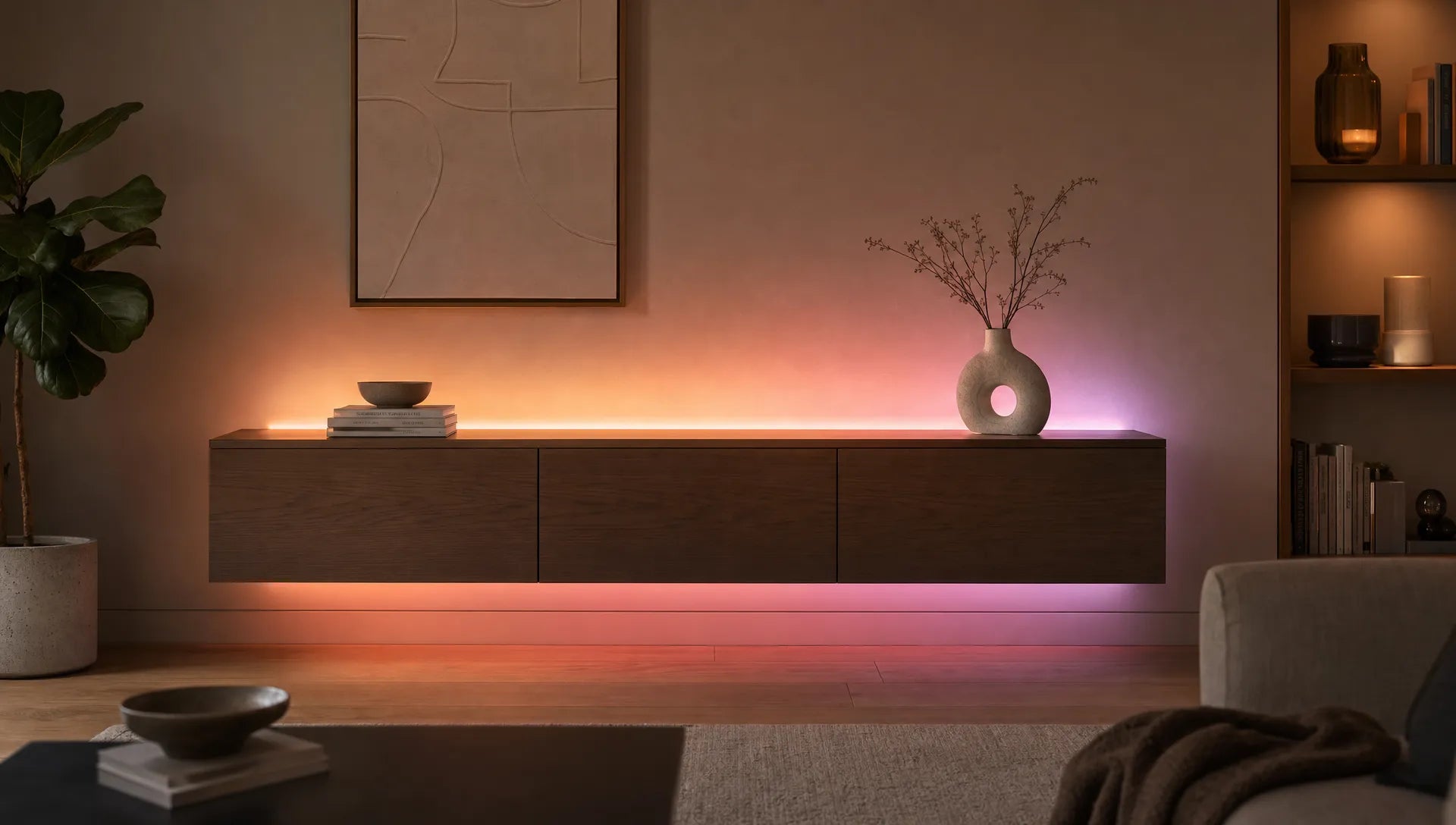
Residential RGB lighting is usually indirect. This means: You don't see the LED itself, but only its light on the wall, ceiling, edge of furniture or floor. This makes colors appear softer, shadows more pleasant and the lighting atmosphere less artificial.
RGB accents work particularly well in places that already have spatial depth: behind the television, under the bed, behind a sideboard, in a niche, on the window frame or along a ceiling joint. Lights that shine colorfully directly into your face or onto the dining table are less suitable.
| Location | Homely effect | What you should pay attention to |
|---|---|---|
| Behind the TV | Relieves eye strain and creates depth | Keep brightness low and do not use bright blue tones permanently |
| Under the bed | Floating, calm effect in the bedroom | Choose warm amber, soft pink or very dim blue |
| Behind sideboard or sofa | Emphasizes furniture and wall space | Mount LEDs invisibly and let the light shine onto the wall |
| On the shelf | Highlights books, ceramics or objects | Use color sparingly and don't illuminate each compartment differently |
| Around windows or niches | Subtly frames architecture | Guide the light line cleanly and hide the cable if possible |
| On stairs or bases | Orientation and atmosphere | Ensure glare-free installation and safe installation |
This placement is particularly important for interior designers, architects and renovators. RGB should not be added as decoration at the end. Ideally, it is decided during the planning stage which areas should absorb light and where power supplies, cables or controls should be sensibly hidden.
Room by room: Where RGB looks homely
Not every room can tolerate the same color intensity. A living room can be more atmospheric than a kitchen, a bedroom quieter than a hobby room. That's why the RGB LED lamp should always match the function of the room.
| space | Good RGB application | Better to avoid |
|---|---|---|
| Living room | Indirect wall accents, TV backlight, shelf lighting | Full-surface red, blue or green as continuous lighting |
| bedroom | Very dimmed light under the bed, behind the headboard or curtain | Dynamic color changes right before sleep |
| Dining area | Subtle background accent on the wall or sideboard | Colored light directly on food and faces |
| Kitchen | Accent on base, niche or open shelf area | RGB as the primary work light on the worktop |
| bathroom | Mood lighting outside of direct wet areas | Installation without suitable moisture protection |
| Home office | Discreet background behind a shelf or monitor | Strongly changing colors in the field of vision |
| hallway | Light line as orientation or accent on a wall | Too dark colors as the only light |
A good rule of thumb is: Natural white light should dominate where people eat, read, work or look at themselves in the mirror. RGB can be used beautifully where atmosphere, depth or architecture are in the foreground.

Concrete application ideas with LED strips and projection light
A flexible LED strip is particularly suitable for soft, indirect color accents. The LED strips colored with remote control is suitable for applications where light needs to be integrated unobtrusively, such as under the bed, behind furniture, behind the television or around a window. Thanks to the flexible placement and the self-adhesive backing, a color accent can be added where the room really needs it.
The mounting edge is important. Do not stick the strip in such a way that individual LED points are directly visible. A concealed position behind the edge of a furniture or in a profile with a diffuser is better. This is how technology becomes a calm light surface.
If you are looking for a graphic wall effect instead of a linear stripe, you can use the LED strip lamp X-Beam Pro work specifically. It projects four rectangular stripes onto the wall and can be adjusted 360° after installation. This makes it particularly suitable for walls that need to be deliberately staged, for example in the hallway, in a lounge corner or as a modern accent next to simple furniture.
Such effects work best when the environment remains calm. A single colored light graphic on a wall can look high quality. However, several competing RGB sources in the same field of view quickly appear arbitrary. You can find further inspiration for creative but controlled use in the article above special lighting effects with LED lamps.
The right colors: less saturation, more atmosphere
Many RGB lamps are initially tried out with maximum color intensity. This is understandable, but rarely livable. In furnished rooms, muted colors are almost always more elegant than pure primary colors.
Amber, warm orange, champagne, sage, petrol, dark blue or a very soft rosé combine better with wood, fabric, stone and metal than bright red, neon green or hard violet. The more natural the materials in the room, the more reserved the color should be.
| hue | Effect | Good application |
|---|---|---|
| Warm amber | cozy, quiet, evening | Living room, bedroom, dining area as background |
| Gentle rosé | soft, elegant, decorative | Bedroom, dressing room, shelf niches |
| Deep blue | concentrated, cool, modern | TV wall, home office background, short scenes |
| Petrol or green blue | high quality, calm, somewhat graphic | Lounge area, hallway, wall accent |
| Red or purple | dramatic, intense, striking | Only for a short time or for special occasions |
The brightness is also crucial. An RGB LED lamp does not have to be bright to be effective. Especially in the evening, 10 to 30 percent brightness is often more pleasant than full power. When the color touches just one wall surface, it creates depth without visually overloading the room.
Controls and scenes: everyday life instead of coincidence
Good RGB lighting isn't complicated, but it does need repeatable settings. If you have to look for the right color every evening, the effect quickly becomes annoying. Fixed scenes for typical situations are better.
Three scenes are enough in many households: a warm evening atmosphere, a subtle movie scene and a colorful accent for guests or special occasions. If you use RGB in the bedroom, you should also save a very dimmed, warm scene that is not activated and does not cause glare.
When making your selection, it is also worth looking at the entire lamp, not just the color function. Lumens, dimming behavior, light distribution, installation location and operation determine whether a solution really fits into everyday life. If you are still at the beginning of the selection, the guide will help you Select the appropriate LED lamp.
RGBW is often a good choice for living spaces if the same luminaire also needs to provide white light. RGBW means there is a white LED channel in addition to red, green and blue. This means that white usually appears more natural and the room can be illuminated both functionally and atmospherically. However, if RGB is only used as an effect, a pure RGB accent is completely sufficient.
Common mistakes when using RGB LED lamps
Many unsettled lighting concepts are not caused by the RGB technology itself, but by incorrect dosage. The following points help to avoid typical planning mistakes:
- Use RGB light as the only light source in the room.
- Mount LED points directly visible, without a diffuser or hidden edge.
- Using too many colors at the same time.
- Permanently activate color changes even though the room should calm down.
- Aim cold or saturated colors in the dining area directly at the table and faces.
- Do not plan power supplies and cables and lay them visibly later.
- Do not use dimming and permanently set RGB too bright.
- Plan for wet rooms without suitable protection and without safe installation.
The last point is particularly important when it comes to renovations. When walls are opened, furniture is installed or ceilings are suspended, power supply, control and maintenance access should be taken into account. A beautifully placed RGB LED lamp loses its effect if the cable, power supply or adhesive strips become visible later.
A simple planning routine for homely RGB lighting
Don't start by asking which color is the most beautiful. Start by asking what mood the room needs. Should it appear calmer, deeper, more modern, more comfortable or more striking? Only then do you choose the position and color.
First check the existing basic lighting. Is there enough warm white light? Can you dim? Are important areas such as tables, sofas, work surfaces or mirrors naturally lit? If this basis is missing, it should be improved before RGB planning.
Then define a single accent zone. This can be a wall behind the sofa, the back of the TV stand, a niche or the area under the bed. A strong accent zone usually looks more elegant than several weak effects throughout the room.
Finally, test the color in the evening. Daylight, wall color and furniture surfaces change perception significantly. A color that appears attractive in the product view may appear completely different on a beige wall than on concrete, wood or white plaster.
FAQ: Use RGB LED lamp in a homely way
Can an RGB LED lamp replace normal warm white light? Only to a limited extent. Pure RGB lights are primarily intended for color accents. Warm white LEDs or RGBW lights with an additional white channel are usually more suitable for comfortable everyday lighting.
Which color looks most comfortable in the living room? Warm amber, muted orange, champagne or very soft rose tones often appear more homely than strong blue, red or green. Low brightness and indirect placement are important.
Where should I avoid using RGB light? RGB is usually unsuitable directly above the dining table, as the main light in the bathroom mirror area or as the only work light in the kitchen. There you need natural, color-stable white light.
Are LED strips better than RGB lamps? That depends on the goal. LED strips are ideal for indirect lines and hidden accents. Individual RGB lamps or projection lights are more suitable when a clear effect or a graphic point of light is desired.
How do I stop RGB lighting from looking cheap? Hide the light source, reduce saturation and brightness, use few colors and always combine RGB with good warm white basic light. Clean installation is just as important as the color itself.
Coziness is created by a well thought-out lighting concept
An RGB LED lamp can make a home more modern, personal and atmospheric when not viewed in isolation. Only when combined with warm basic light, high-quality materials, clear zones and quiet control does a result emerge that does not look like effect lighting, but rather like interior design.
If you want to combine RGB accents with modern lights, see BUYnBLUE a curated selection of designer lighting for different living areas. For pendant lights and chandeliers BUYnBLUE There are also free adjustments, such as cable length, canopy or color, as well as free worldwide shipping and a 14-day return policy.