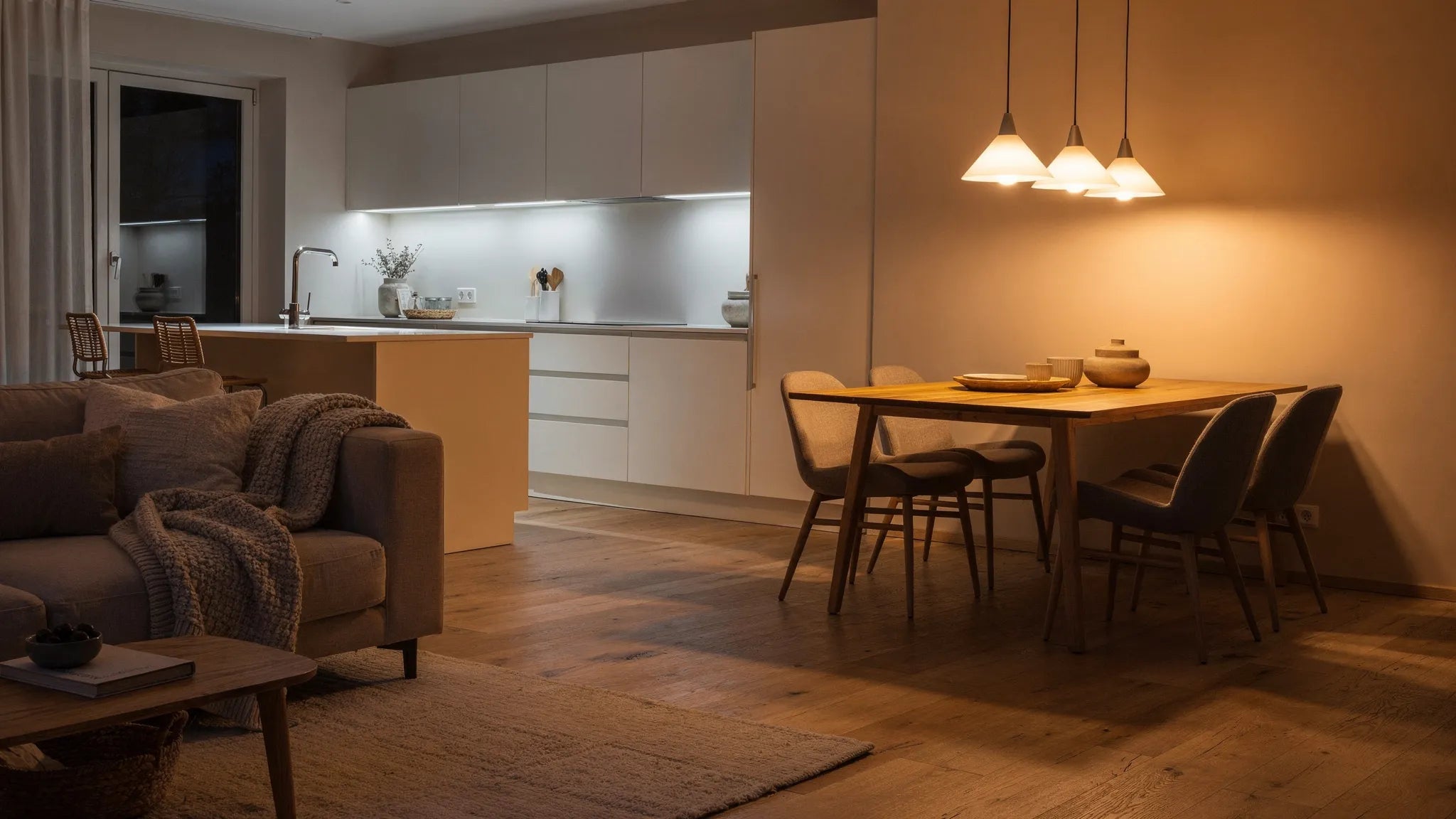
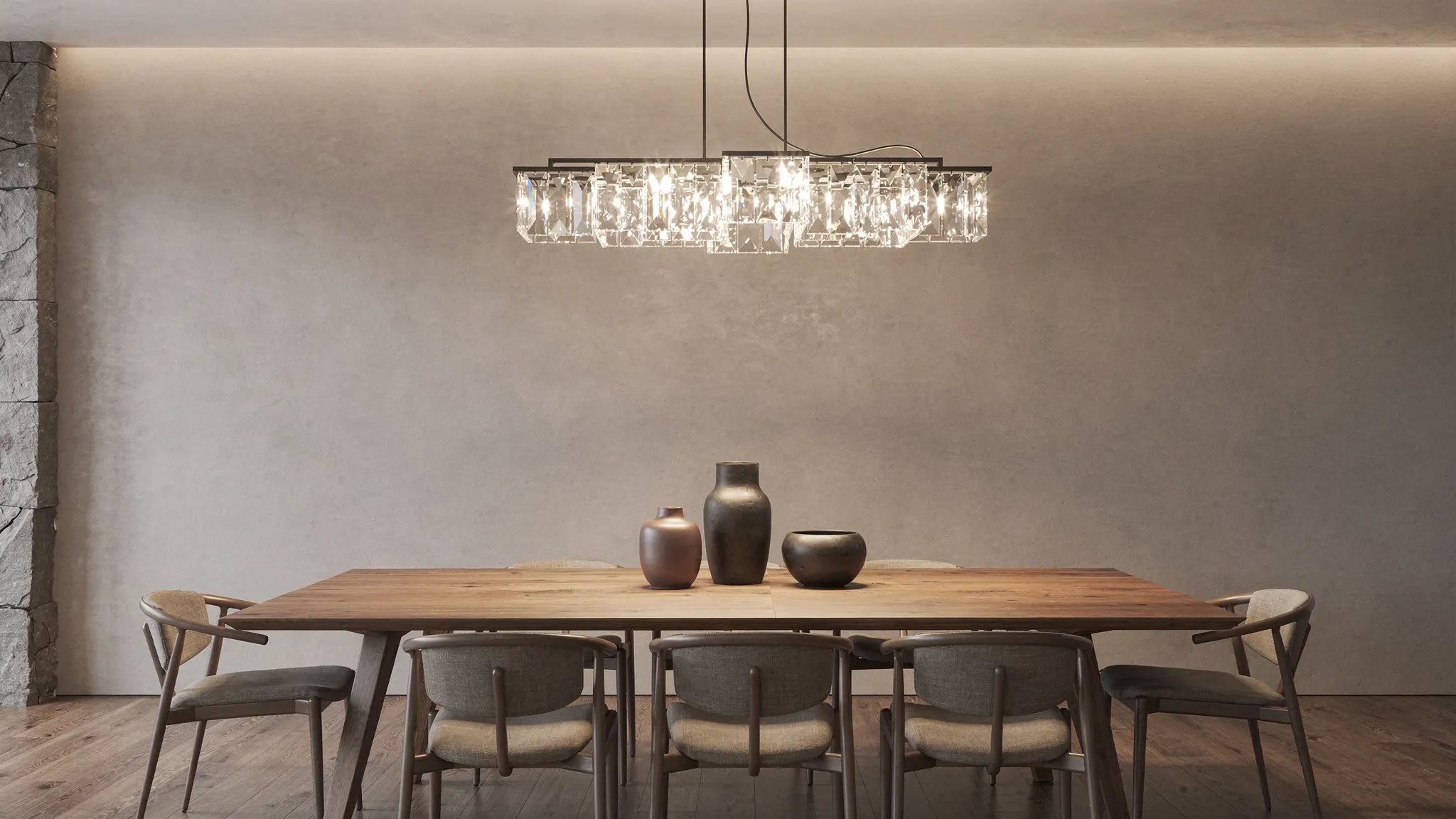
WOFI Villa matt gold: dim the amber glass pendant light correctly
Amber glass looks elegant, but is less forgiving when dimming than a white opal shade. At the WOFI Villa matt gold Added to this is the mix of warm gold tone and tinted glass: the light automatically appears more comfortable, but at the same time the perceived brightness decreases. If you then use “just any dimmer”, you will quickly end up with flickering, humming or a very small dimming range.
This guide shows you how to properly dim an amber glass pendant light like the WOFI Villa without guessing, and what you should pay attention to when it comes to dimmers, bulbs and installation.

Why amber glass needs special attention when dimming
Amber glass filters part of the light (depending on the tint) and visibly shifts the lighting effect towards warmer. This is intentional, but has three practical consequences:
- They often need more light reserve. What is “light enough” with clear glass sometimes seems too dark with amber.
- Color temperature and dimming have a greater impact on mood. A lamp with 2700 K can appear very warm due to amber. When dimmed, it quickly becomes “candlelight”.
- Improper dimming is more noticeable. Flickering or strobe effects are more disturbing in warm, quiet settings because the light is usually used to create atmosphere.
Step 1: Check how your WOFI Villa dims technically (or not)
Before you decide on dimmers or lamps, you need to know which system is in the light. This is almost always stated on the nameplate, packaging or in the instructions.
Variant A: Replaceable light source (e.g. E27 or E14)
Many pendant lights with glass shades use a standard bulb. Then the following applies:
- The lamp itself is “dimmable” if The bulb used is dimmable is and Dimmer plus bulb compatible are.
- They have the most flexibility: light color, CRI, dim-to-warm, brightness.
Important: Not every LED lamp is dimmable, even if it fits into the socket.
Variant B: Integrated LED module with driver
With integrated LEDs, the decision is made Driver (LED driver), how to dim:
- Leading edge/leading edge edge (230 V, suitable for wall dimmers)
- 1–10 V, DALI (more for object areas)
- Proprietary solutions or smart controllers
If the instructions don't mention dimming, the light may be not dimmable or just with a suitable system.
Step 2: Choose the right dimmer (this is usually the crux of the matter)
LED dimming is less “standard” than it used to be with halogen. The combination of dimmer technology, minimum load and LED electronics is crucial.
Phase control vs. phase control (short and practical)
In everyday life you usually come across these two types of wall dimmers:
| Dimmer type | Typical application | In practice often suitable for | Typical symptoms of making the wrong choice |
|---|---|---|---|
| Phase control (leading edge, often TRIAC) | Classic dimmers, previously often used for halogen/incandescent lamps | Some dimmable LED bulbs, but not all | Humming, flickering, light goes out at low level |
| Trailing Edge | Modern electronic dimmers | Very often the better choice for LED | Usually more stable, but also possible with the wrong load: flickering, limitation of the dimming path |
Rule of thumb: If you dim LEDs and have freedom of choice, a good trailing edge dimmer or an explicit “LED universal dimmer” is often the safer option. However, this is only guaranteed if the manufacturer's information matches.
Minimum load and “LED suitable”
Many problems arise because the dimmer requires a minimum load, but the LED draws very little power. Pay attention to:
- Minimum load of the dimmer (can be found in the data sheet/name plate)
- Total load of the luminaire (if there are several lamps: add them together)
If the load is too low, the luminaire can:
- switch off at the lower end of the dimming range
- pulsate visibly
- react with a delay when switching on
Tip for renovators: Document components clearly
If you are retrofitting dimmers as part of a renovation (or converting several rooms), it helps to store dimmer models, data sheets and documents in a structured manner. Digital invoice and receipt management can be practical for teams or multiple objects, for example via a tool like digital invoice management. This saves time when retrofitting or ordering later.
Step 3: Select the right bulb for amber glass
If your WOFI villa uses an exchangeable light source, you have the greatest leverage when it comes to the lighting effect.
1) Light color (Kelvin): It is better to consciously plan warmer
Amber glass makes light warmer. The following often work for living areas:
- 2200-2700K for very cozy (living room, bedroom, evening)
- 2700-3000K if you still want enough “everyday light” (dining area, kitchen-living room)
In a kitchen, amber glass can quickly seem too warm if you really need “work light” while cooking. Then it is often better to see the pendant light as mood light and also combine it with neutral white work light (base, spotlights).
2) Color rendering (CRI): A quality feature, especially for gold and glass
To make materials (wood, brass, gold tones, food) look natural, it is worth using a high CRI. For living spaces it is common CRI 90+ chosen as a quality goal, especially if the lamp hangs decoratively in the field of vision.
3) Dimming behavior: “Just darker” or “Dim-to-warm”?
- Normal dimming: Light becomes darker, the color temperature remains largely the same.
- Dim to warm: When dimming, the light becomes warmer (similar to incandescent lamps).
With amber glass, dim-to-warm can be extremely cozy, but can also become too “orange”. If you use this light in the dining area and want to see clearly, a good 2700 K light bulb with clean dimming is often more balanced.
4) Brightness (lumen): Don't choose too low because of the amber glass
Without knowing the exact glass tint, the most important practical rule is:
- Better plan a little more brightness and then dim down.
This prevents the light from being too dark at 100 percent.
Step 4: Test commissioning correctly (in 10 minutes, without special equipment)
Once dimmers and lamps are installed, test systematically:
Test A: Dimming distance and stability
- Start at 100 percent.
- Dim slowly down to the minimum.
- Look for flickering, sudden shutdowns, or jumps.
Test B: Noise and heat
- Listen quietly: Humming or humming often comes from the dimmer or the driver.
- Check after 15 minutes of operation: If the canopy or dimmer becomes unusually warm, a specialist company should check it.
Test C: Smartphone camera quick check
Film the light with your smartphone camera at different dimming levels. If you see clear streaks or strong pulsing, this is an indication of flicker, which may not always be that severe in reality, but can be a warning sign.
Common problems with dimming and what lies behind them
Most dimming problems can be traced back to a few causes.
| Symptom | Probable cause | Which often helps in practice |
|---|---|---|
| Flickering at low levels | Minimum load does not fit, dimmer bulbs incompatible | Choose a dimmer suitable for LEDs and test another dimmable light source |
| Light goes off at 20-30 percent | Dimmer has too high a minimum load or poor control range | Dimmer with better LED control range, check load |
| Humming/buzzing | Phase control on unsuitable LED, mechanical resonance | Trailing edge dimmer, high-quality lamp, check wiring |
| Light only dims in the first 30 percent | The lamp only allows for a small dimming path | Different light source (better dimming profile), replace dimmer |
| Light dims “jerkily” | Electronics cannot handle PWM/phase control properly | Check compatibility, if necessary universal LED dimmer |
Safety Notice: If you notice unsafe wiring, heat, odor, or visible damage, Switch off the circuit and call in an electrician.
Dimming setup according to room: This is how the WOFI Villa with amber glass works best
Above the dining table
- Goal: Glare-free, cozy, but sufficiently bright for eating and tidying up.
- Recommendation: bulbs with good color rendering (CRI high), brightness not too low, dimmer for scenes.
- Practice: Set two “fixed points”, for example “Dinner” (dimmed) and “Everyday life” (brighter).
Living room
- Goal: Atmosphere, reflections in the amber glass may be visible.
- Recommendation: warm white, optional dim-to-warm. Add indirect light (floor or wall lights) so that the pendant light does not have to provide all the light alone.
bedroom
- Goal: Very warm, very quiet.
- Recommendation: Very warm lamp or dim-to-warm, but with little flicker and stable dimmability.
Hallway or entrance area
- Goal: Welcome but functional.
- Recommendation: If amber glass appears too dark, it is better to use higher lumens and dim it slightly in everyday life.
Mini checklist: How to buy dimmers and bulbs without making a mistake
- Check whether the light uses a replaceable light source or an integrated LED module.
- Choose one explicitly dimmable LED bulbs (if replaceable).
- Use one LED-suitable dimmer and pay attention to minimum load and compatibility information.
- Plan at Amber Glass Brightness reserve and dim to the mood.
- After installation, test the entire dimming path and pay attention to noise.
Frequently Asked Questions (FAQ)
Can I dim the WOFI Villa matt gold with any dimmer? No. Whether it works depends on the lighting technology (bulbs or LED driver) and the type of dimmer (leading edge/leading edge/LED universal dimmer).
Which light color goes best with amber glass? For cozy rooms usually warm white (approx. 2200-3000 K). Amber glass also makes the light warmer, so it's worth testing carefully.
Why does the pendant light flicker when dimming? Dimmers and LED lamps often do not fit together or the minimum load is not reached. Sometimes the LED driver is not designed for the selected type of dimming.
Does dim-to-warm make sense with amber glass? Can be very atmospheric, but gets very warm quickly. If you also need “practical” light, a good warm white bulb with clean dimming is often more flexible.
Should I connect the dimmer and light myself? This is possible if you have experience and adhere to all safety rules, but if you are unsure, there is no protective conductor, old wiring or any abnormalities, an electrician should take over.
Suitable alternatives and advice: If you love amber glass but you want it to fit perfectly
If you like the look of amber glass and gold tones, but are looking for a pendant light that can be precisely adjusted to the ceiling height and floor plan, it's worth taking a look at the curated selection at BUYnBLUE. There you will find modern designer lights and benefit from many chandeliers and pendant lights free customizations (for example cable length, canopy or color), as well as free worldwide shipping and a 14-day return policy.
Browse the shop at BUYnBLUE or contact support if you would like to clarify which combination of light, bulb and dimmer suits your room before purchasing.