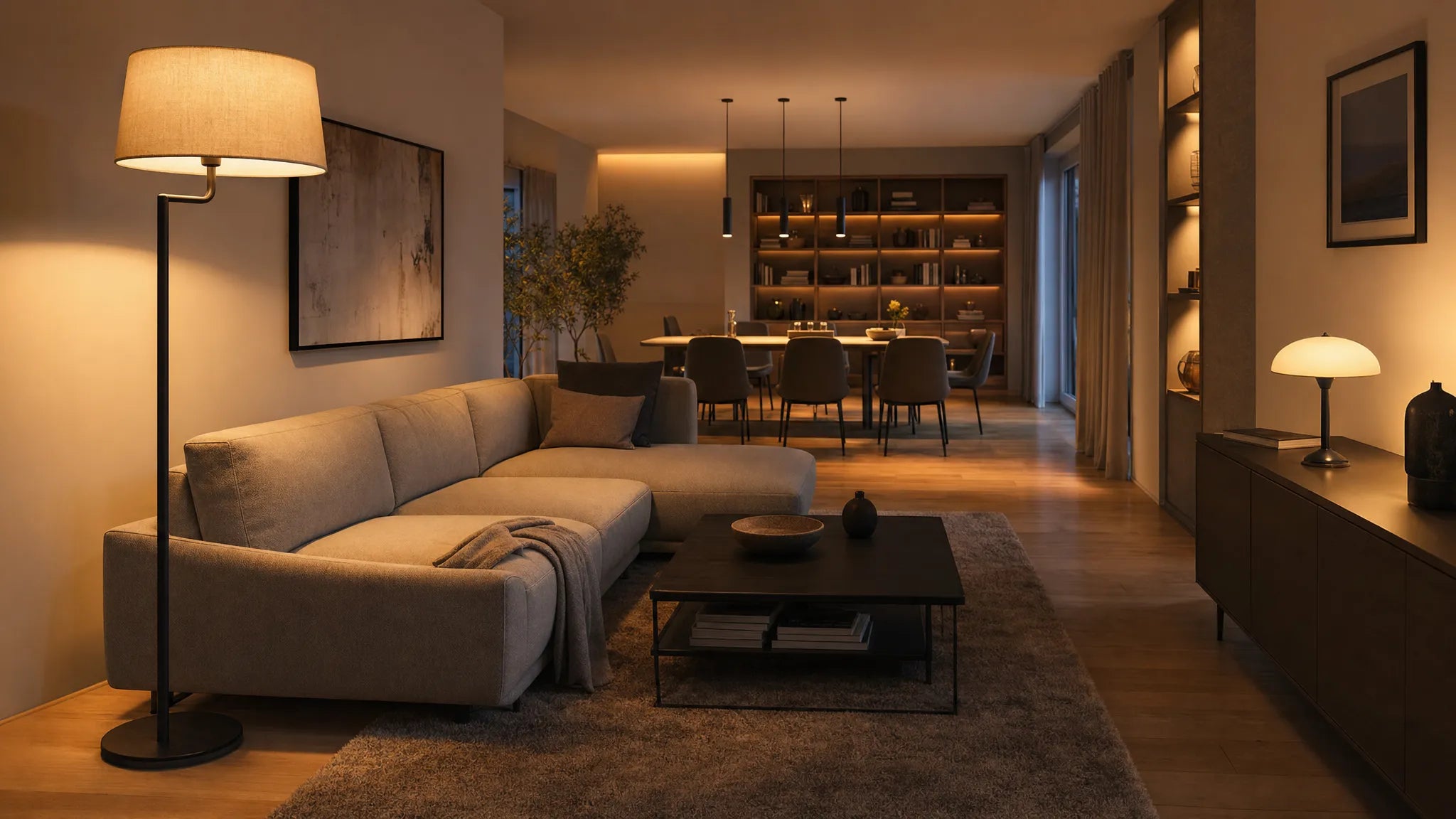
Plan Japandi lighting correctly for quiet rooms
Japandi thrives on calm, lightness and consciously placed details. This is exactly why lighting is so crucial in this style: a single overbright ceiling lamp can make the room appear harsh and busy, while multiple soft light sources create structure, warmth and depth.
If you want to plan Japandi lighting correctly, you should think less about individual lamps and more about lighting moods. It's about glare-free light, natural materials, warm to neutral warm light colors and a clear hierarchy of light sources. This creates a space that appears reduced, but never empty or cool.
What Japandi lighting is all about
Japandi combines Japanese restraint with Scandinavian comfort. In lighting this means: not as much light as possible, but the right light in the right place. The room should function without becoming visually noisy.
Good Japandi lighting follows five basic principles:
- Soft instead of hard: Light is used diffusely, indirectly or well shielded so that no bright spots of light appear.
- Zoned instead of flat: Sofa, dining table, reading chair, bed or sideboard have their own islands of light.
- Warm instead of cool: Warm white light supports wood, textiles, stone and ceramics particularly harmoniously.
- Natural instead of artificially flashy: Materials such as paper, linen, wood, bamboo, ceramic, glass or matt metal fit better than high-gloss effects.
- Reduced instead of decoratively overloaded: A lamp can be beautiful, but it should not dominate the room.
The important thing is: Japandi is not dark. Quiet rooms certainly need sufficient brightness, but it should be even, pleasant and flexibly controllable.

First read the room, then select lights
The most common mistake when planning lighting is to first buy a nice lamp and only then consider whether it fits the room. With Japandi it works better the other way round: first analyze the room, then choose the lights.
Look at where daylight comes in, which areas are used in the evening and which lines of sight are important. An open living-dining area needs different light zones than a small bedroom. A room with dark wooden floors needs more gentle brightening than a room with light walls and lots of natural light.
Helpful questions before planning include:
- Where do you really sit, read, eat or work?
- Which wall or piece of furniture should be emphasized?
- Where would direct light cause glare, such as on the sofa, at the dining table or in bed?
- Which materials should look particularly beautiful through the light?
- Is there just one ceiling connection or several power points?
Once these questions are clarified, the selection becomes much easier. Instead of “Which lamp do I like?” The better question is: “What lighting effect does this area need?”
The three layers of light for quiet Japandi rooms
Even in the Japandi style, the tried and tested principle of basic light, zone light and accent light remains useful. The difference lies in the design: the lights appear quieter, the light cones are softer, and the transitions between light and dark appear more natural.
| light layer | task in the room | Suitable Japandi lights | What to pay attention to? |
|---|---|---|---|
| Basic light | Orientation and uniform brightness | Simple ceiling lights, diffuse pendant lights, indirect wall or ceiling lighting | Not too bright, plan dimmable |
| Zone light | Light for reading, eating, cooking or working | Pendant lights over the table or kitchen island, floor lamps, table lamps, wall lights | Glare-free, targeted and functional |
| Accent light | Depth, atmosphere and material effect | Small table lamps, LED light strips, up-and-down wall lights, spots on plants or ceramics | Use sparingly, no show effects |
Accent lighting in particular often determines whether a room appears calm or flat. A softly lit wall, a warm light on a wooden surface or a small lamp on a sideboard creates more of a Japandi atmosphere than an oversized central light source.
If you would like to learn more about the 3-layer principle from a technical perspective, it is also worth it BUYnBLUE Guide to LED lighting with 3-layer light.
Color temperature: warm, but not yellowish
The light color is a central factor for Japandi lighting. Light that is too cool quickly appears technical and uncomfortable. Light that is too yellow can distort natural materials and make the room feel heavy.
For living areas is usually 2700 Kelvin ideal. This looks warm, cozy and goes well with wood, linen, clay, natural stone and warm wall colors. Can be used in kitchens, work areas or bathrooms 3000 Kelvin make sense because it looks a little clearer without appearing cold.
Dimmable lights are helpful for particularly quiet evening atmospheres in the bedroom or living room. If the light is reduced, the room automatically appears softer. Dim-to-warm is also interesting for some lights, where the light becomes warmer when dimmed.
| area | Recommended light color | Effect in the Japandi area |
|---|---|---|
| Living room | 2700K | Warm, soft and relaxing |
| Dining area | 2700K to 3000K | Cozy, but clear enough for the table and food |
| bedroom | 2200K to 2700K | Very quiet, especially pleasant in the evening |
| Kitchen work surface | 3000K | Clearer and more functional without appearing sterile |
| Bathroom mirror area | 3000K | More natural perception of skin tones |
| hallway | 2700K to 3000K | Inviting and orientating |
Also pay attention to good color reproduction. A CRI or Ra of at least 90 is particularly recommended at Japandi because it makes natural materials, textiles and wall colors appear more authentic.
Adjust brightness correctly: quiet rooms need reserves
Minimalism is often confused with low light. This leads to rooms that, although furnished in a reduced style, appear gloomy or impractical in the evening. A lighting concept with sufficient brightness that can be dimmed and zoned is better.
The following values are guidelines for planning. The actual effect depends on the size of the room, wall colors, ceiling height, lamp shape and surfaces.
| room or zone | Rough orientation | Planning tip for Japandi |
|---|---|---|
| Living room basic light | approx. 100 to 150 lux | It's better to have several gentle sources than a bright center |
| Reading place | approx. 300 to 500 lux | Use direct light, but shield the umbrella well |
| Dining area | approx. 150 to 250 lux | Choose a dimmable pendant light |
| Bedroom basic light | approx. 50 to 100 lux | Prefer warm and low light sources |
| Kitchen work surface | approx. 300 to 500 lux | Combine functional light with warm ambient light |
| hallway | approx. 100 lux | Lighten walls slightly instead of just lighting the floor |
The following applies to the conversion: Lux describes the brightness on a surface. Lumen describes the luminous flux of a lamp. A 20 m² living room with a basic brightness of 100 lux mathematically requires around 2000 lumens, in practice often a little more because shades, wall colors and beam angles absorb light.
The matching lamp shapes in Japandi style
Japandi lights rarely appear spectacular in the classic sense. Their strength lies in proportion, material and light distribution. Good shapes are clear, organic or inspired by craftsmanship. They can be visible, but they should calm the room.
Pendant lights
Pendant lights fit particularly well over a dining table, coffee table, kitchen island or bedside table. Shades made of paper, fabric, wood veneer, opal glass or matt metal work particularly well in the Japandi style. It is important that the lamp does not directly dazzle.
The lower edge of a pendant light often hangs above the dining table 60 to 75 cm above the table top. For very large or high rooms, the optimal height may vary. It is crucial that the lamp fits the table but does not disturb the view.
Wall lights
Wall lights are ideal for creating calm. They illuminate vertical surfaces, make rooms visually softer and avoid the harsh impression of a ceiling lamp alone. Up-and-down lights, simple umbrellas or small wall spotlights can subtly structure hallways, bedrooms and living rooms.
Table and floor lamps
Table lamps on sideboards, bedside tables or window sills are particularly valuable in the Japandi style. They bring light to eye level and create intimate zones. Floor lamps next to the sofa or reading chair complement the concept if there is no additional ceiling connection.
Ceiling lights
Ceiling lights should be as quiet as possible in the Japandi room. Flat, diffuse models, opal covers or simple geometric shapes are more suitable than heavily playful designs. If a ceiling light provides the basic brightness, it should be dimmable and supplemented by other light sources.
Materials: Make naturalness visible
The lighting should support the material world of the Japandi style. Wood appears more lively in warm light. Linen and paper diffuse light in a pleasantly soft way. Ceramics and stone gain depth through lateral light. Opal glass ensures quiet diffusion.
These combinations are particularly harmonious:
- Light wood with warm white light and matt white
- Dark wood with paper, linen or opal glass
- Beige walls with black or bronze accents
- Natural stone with side grazing light
- Ceramics and clay with small, low light sources
Avoid too many different surfaces. If there is already a lot of wood, textured plaster and textile, the lamp should remain simple. If the room is very minimalist, a handcrafted-looking pendant light made of natural material can be the focal point.
Room-by-room: Plan Japandi lighting practically
Living room
The living room is about relaxation, conversations and flexible use. A single bright ceiling light rarely has a harmonious effect here. A combination of soft basic lighting, a floor or table lamp on the sofa and accent lighting on the wall, shelf or sideboard is better.
Plan around three to five light sources, depending on the size of the room. A diffuse ceiling or pendant light can form the basis. A floor lamp creates reading light. A small table lamp or indirect light line adds depth. It is important that all light sources are chosen with a similar light color.
Dining area
The dining table is often the quietest focal point of a Japandi room. A pendant light should visually collect the table, but not appear too massive. Round lights go well with round tables, linear or several small pendant lights go well with long tables.
Dimmability is particularly important here. The light can be clear enough when eating, but later it can be reduced for conversations or a quiet evening. If the ceiling outlet is not exactly above the table, a suitable ceiling rose or an adapted suspension can help.
bedroom
The light in the bedroom should bring the day to a close. Bright, cool ceiling lighting is usually counterproductive here. Warm white bedside lamps, wall lamps next to the bed and soft ambient lighting that does not shine directly into your face are better.
You still need directed light to read in bed. A swiveling wall lamp or a table lamp with a well-shielded shade is more practical than a purely decorative model. The remaining light can remain very soft and low.
Kitchen
Japandi kitchens often appear clear, reduced and with an emphasis on materials. Nevertheless, the work surface must be sufficiently bright. Combine functional work light with homely room light. Under-cabinet lights or directional lights above the work surface can be complemented with pendant lights above the island or dining table.
For work surfaces, 3000 Kelvin is usually more pleasant than very warm light because colors and food appear clearer. In the adjacent dining area it can be warmer and dimmed.
Hallway and entrance area
The hallway determines the first impression. In the Japandi style, it should appear calm, tidy and inviting. Wall lights, indirect light or a simple ceiling light provide orientation without harshly illuminating the area.
Vertical light is particularly effective: when walls are slightly brightened, the hallway appears larger and friendlier. Small accent lights on a console or next to a plant can add additional warmth.
bathroom
A bathroom can also radiate Japandi calm if functional light and atmosphere are planned separately. The mirror needs clear, even light. On the other hand, warm, dimmed light is more pleasant for the bathtub, shower or evening routine.
Be sure to pay attention to the appropriate IP protection class in the bathroom depending on the installation area. Provides for details BUYnBLUE your own guide for Bathroom lamp and IP protection class.
Why proportions are so important for Japandi lights
Japandi rooms work through balance. A lamp that is too large can visually weigh down the room. A light that is too small will be lost and appear random. Accurate measurements are particularly worthwhile for pendant lights, chandeliers and lights above tables.
Take into account ceiling height, table size, room volume and lines of sight. In open living areas, the lamp should not only match the size of the furniture, but also look calm from adjacent areas. With high ceilings, a longer suspension is often necessary so that the light does not stay too high up and the table appears disconnected.
This is where individual customization becomes particularly relevant. BUYnBLUE offers a free customization service for chandeliers and pendant lights, for example for cable length, ceiling rose or color. This is particularly helpful for Japandi rooms because small differences in height, position or finish can have a major impact on the overall effect.
Common mistakes with Japandi lighting
Many rooms lose their calm effect not because of incorrect furniture, but because of inappropriate light. These errors are particularly typical:
- Use only a central ceiling lamp: This makes the room flat and often uncomfortable.
- Choose a light color that is too cool: 4000 Kelvin or more quickly appears matter-of-fact instead of calm in living areas.
- Allow lamps to be visibly dazzled: Open umbrellas look nice, but can be a nuisance in everyday life.
- Put too many accents: Japandi needs breaks. Not every niche needs to be illuminated.
- Ignore materials: High gloss, bright chrome or colorful RGB light rarely match the calm Japandi aesthetic.
- Forgot dimmer: Without dimmability, the most important option for adjusting the mood is missing.
A good lighting concept can appear unobtrusive during the day and show its strength in the evening. This is often a sign that the planning has been successful.
Mini checklist for your Japandi lighting planning
- Roughly map out the room with furniture, windows and existing connections.
- Mark all usage zones such as eating, reading, relaxing, working or dressing.
- Determine for each zone whether basic light, zone light or accent light is needed.
- Choose predominantly 2700 Kelvin for living areas and around 3000 Kelvin for work areas.
- Look for glare-free shades, diffuse materials and a CRI of ideally at least 90.
- Check the proportions, suspension height, cable length and position of the ceiling rose before purchasing.
- Plan for dimmers or separate circuits to keep the space flexible.
If you already know that a pendant light or chandelier needs customization, it's worth choosing through a provider with a personalization service. This means that the lamp not only fits stylistically, but also spatially.
Frequently Asked Questions
Which light color suits Japandi lighting best? Warm white light of around 2700 Kelvin is usually ideal for the living room, dining area and bedroom. 3000 Kelvin can be useful in kitchens, bathrooms or work areas because it appears a little clearer.
How many lamps does a Japandi living room need? For a medium-sized living room, three to five light sources often make sense. This includes soft basic lighting, a reading or zone light and one or two accent lights.
Are Japandi style pendant lights suitable? Yes, especially over dining tables, kitchen islands or bedside tables. Natural materials, good proportions, glare-free light and a suitable suspension height are important.
Does indirect lighting suit Japandi? Very good, as long as it stays subtle. Indirect light on the wall, ceiling or furniture supports the calm effect, but should not dominate like a technical effect.
Which materials look particularly harmonious in Japandi lights? Paper, linen, wood, bamboo, ceramics, opal glass and matt metals work particularly well. A natural, reserved surface is crucial.
Does Japandi lighting always need dimmable lights? Not mandatory, but dimmability is highly recommended. It makes the space more flexible and helps to create functional light during the day and calm light in the evening.
Quiet spaces start with precise light
Japandi lighting is not a question of individual trend lights. It is created through good planning: warm light colors, glare-free shades, natural materials, harmonious proportions and several quiet light zones.
At BUYnBLUE You will find a curated selection of modern designer lights for different living areas. Particularly practical for Japandi concepts: pendant lights and chandeliers can be adjusted free of charge, for example in terms of cable length, ceiling rose or color. This means that the lamp fits into your home not only visually but also spatially.
Discover modern lighting for calm, timeless interiors and plan your light so that it feels natural.